Encountering the Divine Mother in Hindu and Christian Hymnsã¢ââ Religion and the Arts
This study is Pew Research Center's about comprehensive, in-depth exploration of Bharat to appointment. For this report, we surveyed 29,999 Indian adults (including 22,975 who identify as Hindu, 3,336 who identify as Muslim, 1,782 who identify as Sikh, i,011 who place as Christian, 719 who identify as Buddhist, 109 who identify as Jain and 67 who place equally belonging to another organized religion or as religiously unaffiliated). Interviews for this nationally representative survey were conducted contiguous nether the direction of RTI International from November. 17, 2019, to March 23, 2020.
To improve respondent comprehension of survey questions and to ensure all questions were culturally appropriate, Pew Research Center followed a multi-phase questionnaire development procedure that included adept review, focus groups, cognitive interviews, a pretest and a regional pilot survey before the national survey. The questionnaire was developed in English and translated into xvi languages, independently verified by professional linguists with native proficiency in regional dialects.
Respondents were selected using a probability-based sample design that would permit for robust analysis of all major religious groups in India – Hindus, Muslims, Christians, Sikhs, Buddhists and Jains – every bit well as all major regional zones. Data was weighted to account for the unlike probabilities of selection among respondents and to align with demographic benchmarks for the Indian developed population from the 2011 census. The survey is calculated to take covered 98% of Indians ages 18 and older and had an 86% national response rate.
For more data, run into the Methodology for this report. The questions used in this analysis can be found hither.
More than 70 years after India became gratuitous from colonial rule, Indians mostly feel their land has lived upward to one of its post-independence ideals: a society where followers of many religions can live and practice freely.
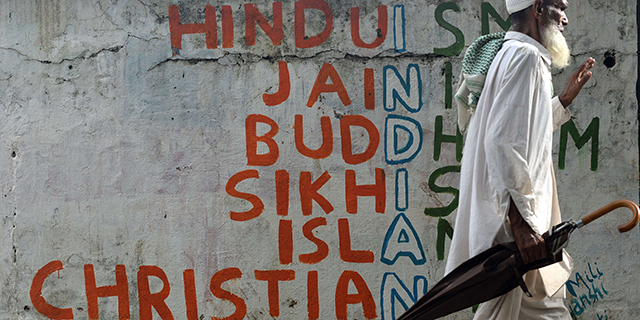
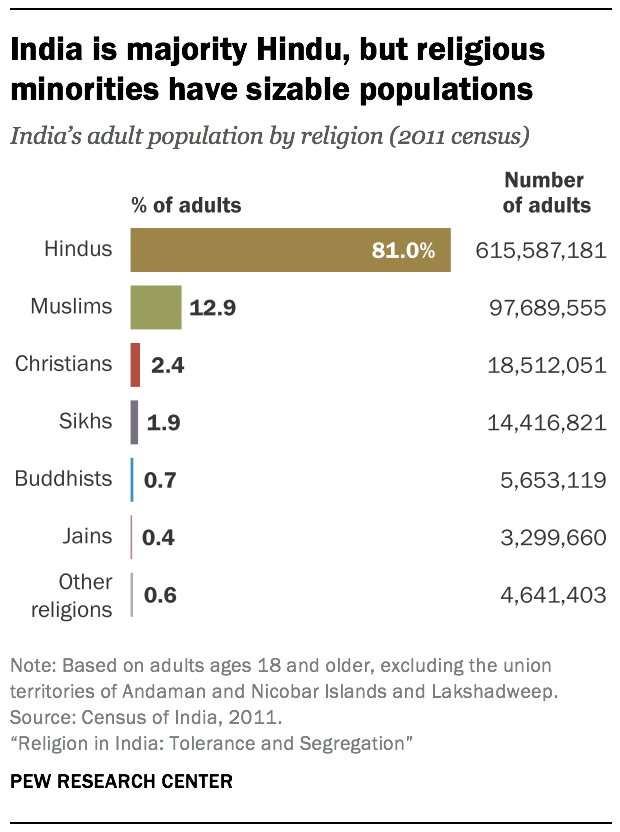
Bharat's massive population is diverse as well every bit devout. Non only do most of the world's Hindus, Jains and Sikhs live in India, but information technology likewise is abode to i of the globe'due south largest Muslim populations and to millions of Christians and Buddhists.
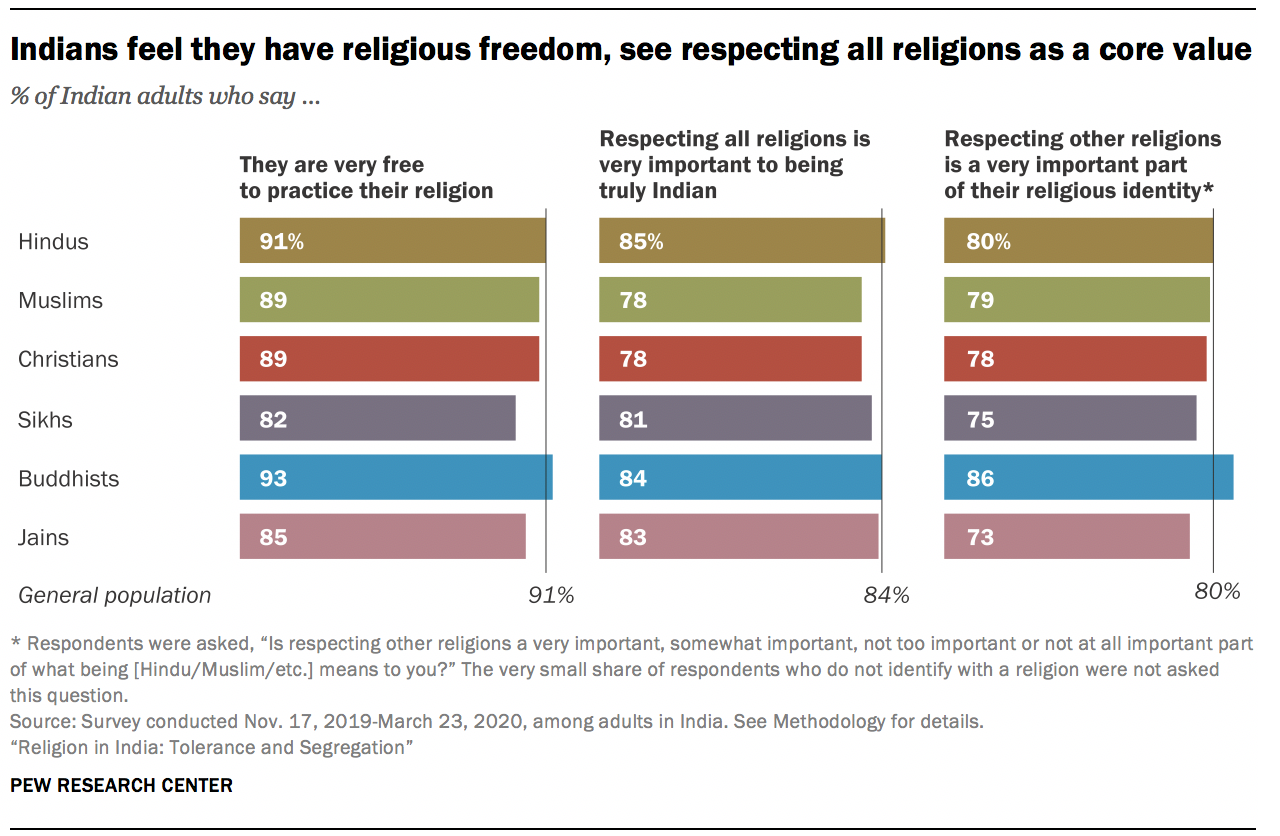
A major new Pew Research Middle survey of religion across India, based on most 30,000 face-to-face interviews of adults conducted in 17 languages betwixt belatedly 2019 and early 2020 (before the COVID-xix pandemic), finds that Indians of all these religious backgrounds overwhelmingly say they are very free to practice their faiths.
Indians encounter religious tolerance as a central part of who they are as a nation. Across the major religious groups, most people say information technology is very important to respect all religions to be "truly Indian." And tolerance is a religious also every bit civic value: Indians are united in the view that respecting other religions is a very important role of what it means to be a member of their own religious community.
These shared values are accompanied past a number of beliefs that cross religious lines. Not only practise a bulk of Hindus in Bharat (77%) believe in karma, simply an identical per centum of Muslims practise, too. A third of Christians in India (32%) – together with 81% of Hindus – say they believe in the purifying ability of the Ganges River, a central conventionalities in Hinduism. In Northern India, 12% of Hindus and x% of Sikhs, along with 37% of Muslims, identity with Sufism, a mystical tradition most closely associated with Islam. And the vast majority of Indians of all major religious backgrounds say that respecting elders is very of import to their religion.
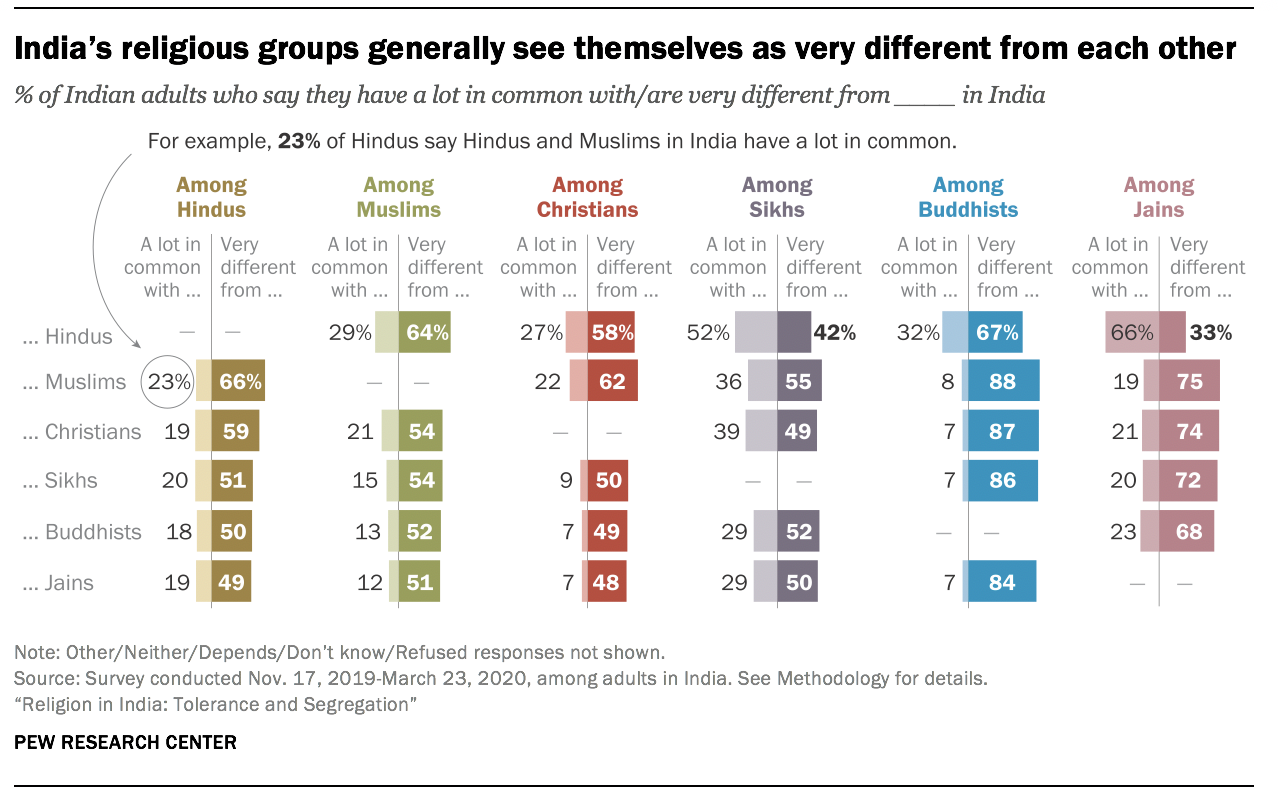
Yet, despite sharing certain values and religious beliefs – besides as living in the same country, nether the same constitution – members of India'due south major religious communities ofttimes don't feel they have much in common with 1 another. The majority of Hindus come across themselves as very unlike from Muslims (66%), and most Muslims render the sentiment, proverb they are very different from Hindus (64%). There are a few exceptions: Two-thirds of Jains and about half of Sikhs say they have a lot in common with Hindus. But more often than not, people in Republic of india'southward major religious communities tend to meet themselves as very different from others.
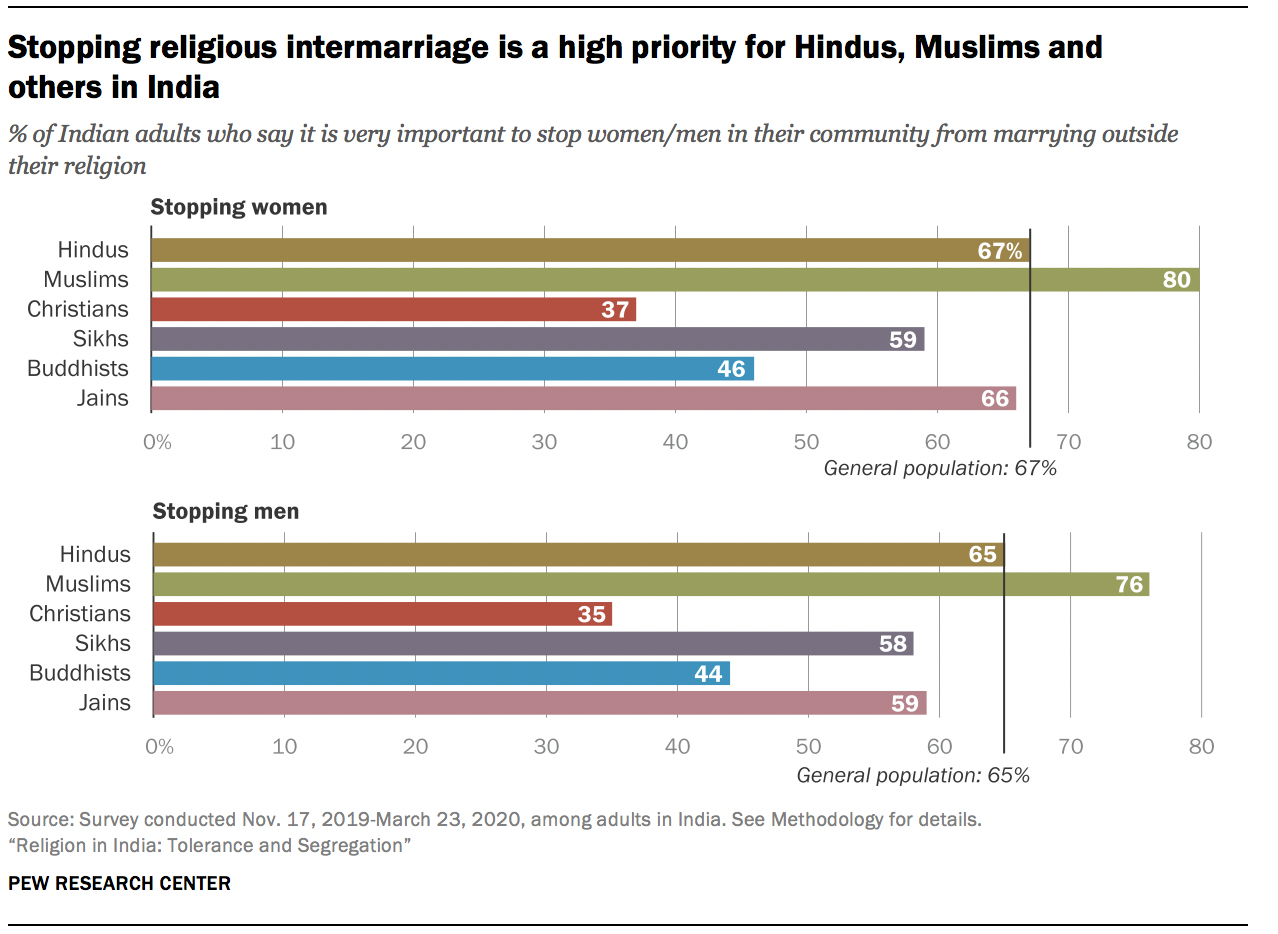
This perception of deviation is reflected in traditions and habits that maintain the separation of India's religious groups. For example, marriages beyond religious lines – and, relatedly, religious conversions – are exceedingly rare (see Chapter three). Many Indians, across a range of religious groups, say it is very of import to stop people in their community from marrying into other religious groups. Roughly two-thirds of Hindus in India want to prevent interreligious marriages of Hindu women (67%) or Hindu men (65%). Even larger shares of Muslims feel similarly: 80% say it is very important to end Muslim women from marrying outside their faith, and 76% say it is very of import to cease Muslim men from doing so.
Moreover, Indians generally stick to their ain religious grouping when it comes to their friends. Hindus overwhelmingly say that about or all of their close friends are also Hindu. Of course, Hindus make up the majority of the population, and as a result of sheer numbers, may be more likely to interact with beau Hindus than with people of other religions. But fifty-fifty among Sikhs and Jains, who each class a sliver of the national population, a big majority say their friends come mainly or entirely from their small religious customs.
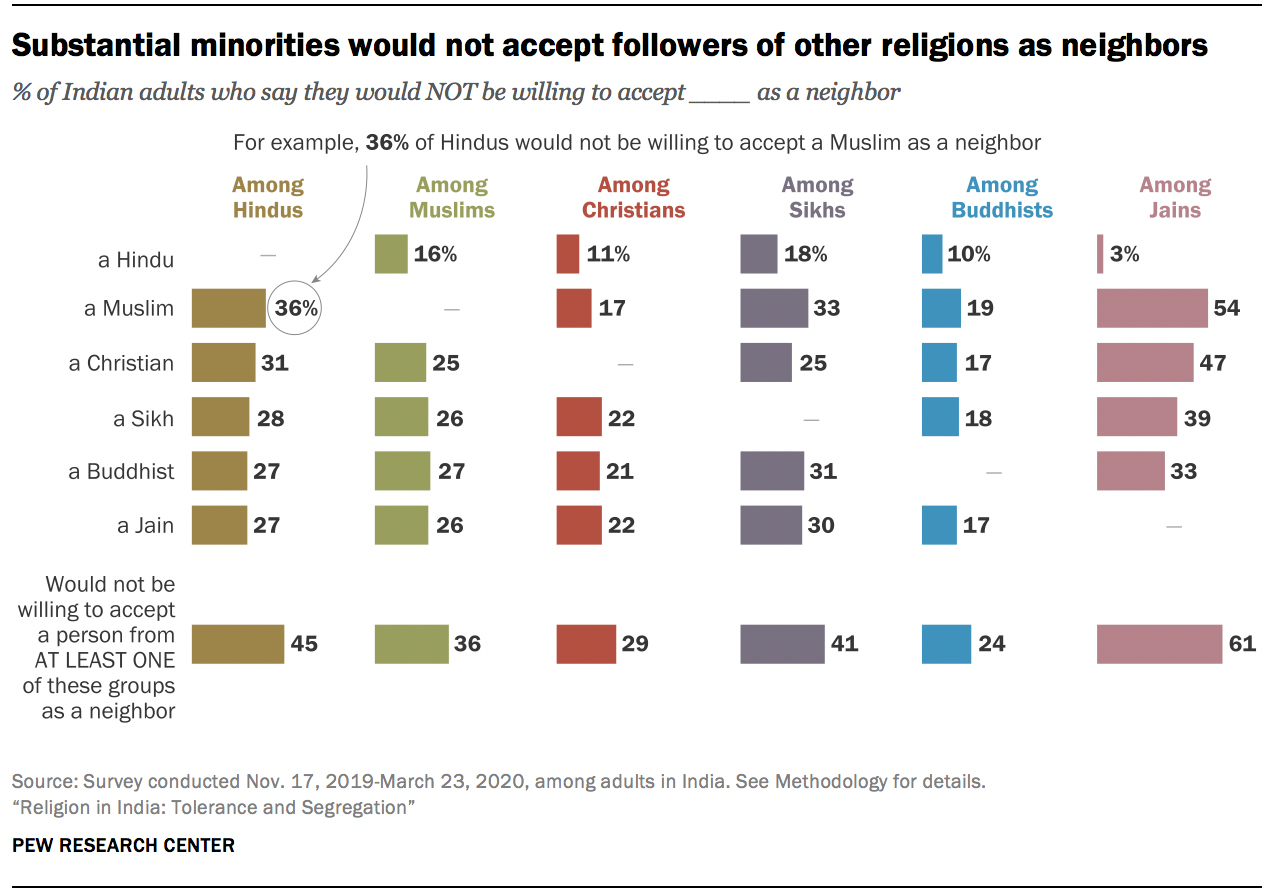
Fewer Indians go so far as to say that their neighborhoods should consist but of people from their own religious grouping. Still, many would prefer to keep people of certain religions out of their residential areas or villages. For example, many Hindus (45%) say they are fine with having neighbors of all other religions – be they Muslim, Christian, Sikh, Buddhist or Jain – but an identical share (45%) say they would not exist willing to accept followers of at to the lowest degree one of these groups, including more than than ane-in-three Hindus (36%) who practice not want a Muslim as a neighbor. Among Jains, a majority (61%) say they are unwilling to have neighbors from at least 1 of these groups, including 54% who would non accept a Muslim neighbor, although nearly all Jains (92%) say they would be willing to have a Hindu neighbor.
Indians, then, simultaneously express enthusiasm for religious tolerance and a consequent preference for keeping their religious communities in segregated spheres – they live together separately. These ii sentiments may seem paradoxical, simply for many Indians they are not.
Indeed, many have both positions, maxim it is important to exist tolerant of others and expressing a want to limit personal connections beyond religious lines. Indians who favor a religiously segregated lodge also overwhelmingly emphasize religious tolerance every bit a core value. For instance, among Hindus who say it is very important to finish the interreligious marriage of Hindu women, 82% also say that respecting other religions is very important to what it means to exist Hindu. This effigy is nearly identical to the 85% who strongly value religious tolerance among those who are not at all concerned with stopping interreligious spousal relationship.
In other words, Indians' concept of religious tolerance does not necessarily involve the mixing of religious communities. While people in some countries may aspire to create a "melting pot" of dissimilar religious identities, many Indians seem to adopt a land more than similar a patchwork fabric, with clear lines between groups.
The dimensions of Hindu nationalism in Bharat
1 of these religious fault lines – the relationship between India's Hindu majority and the country'south smaller religious communities – has particular relevance in public life, especially in contempo years under the ruling Bharatiya Janata Party (BJP). Led by Prime Minister Narendra Modi, the BJP is often described as promoting a Hindu nationalist ideology.
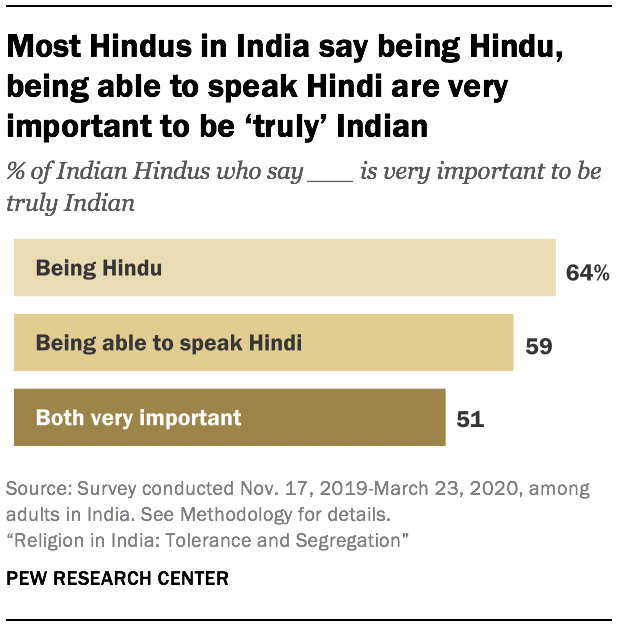
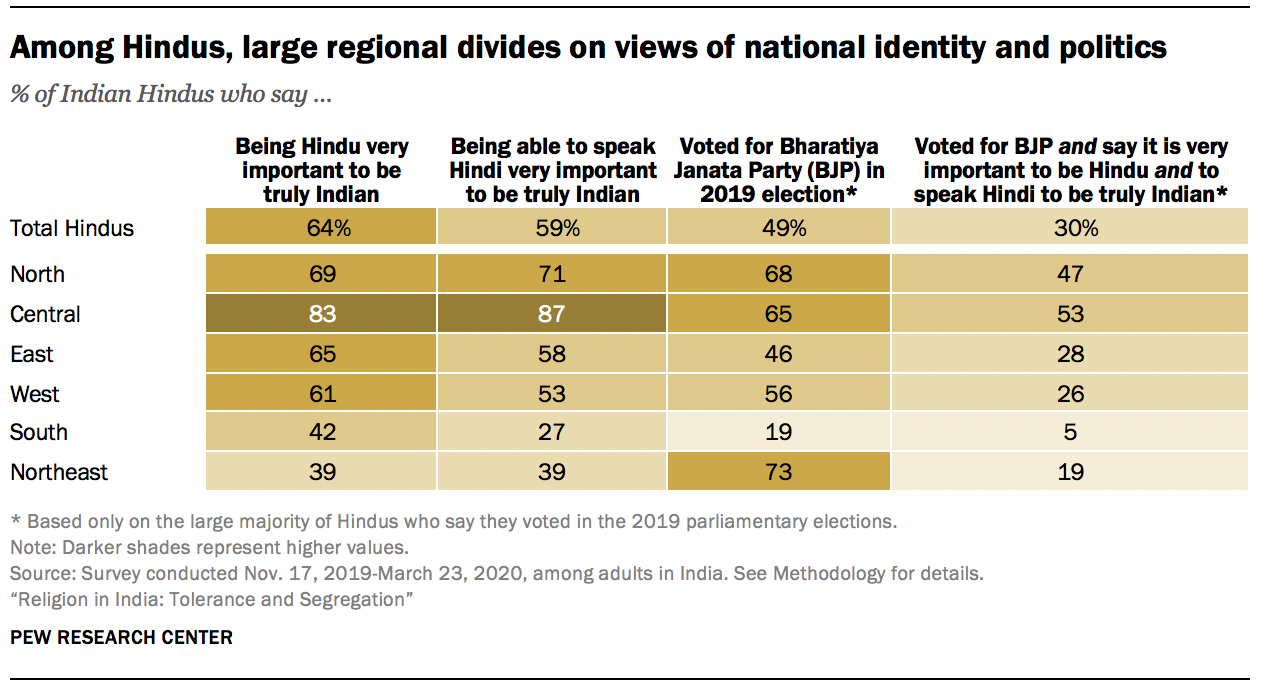
The survey finds that Hindus tend to see their religious identity and Indian national identity as closely intertwined: Almost two-thirds of Hindus (64%) say it is very important to be Hindu to be "truly" Indian.
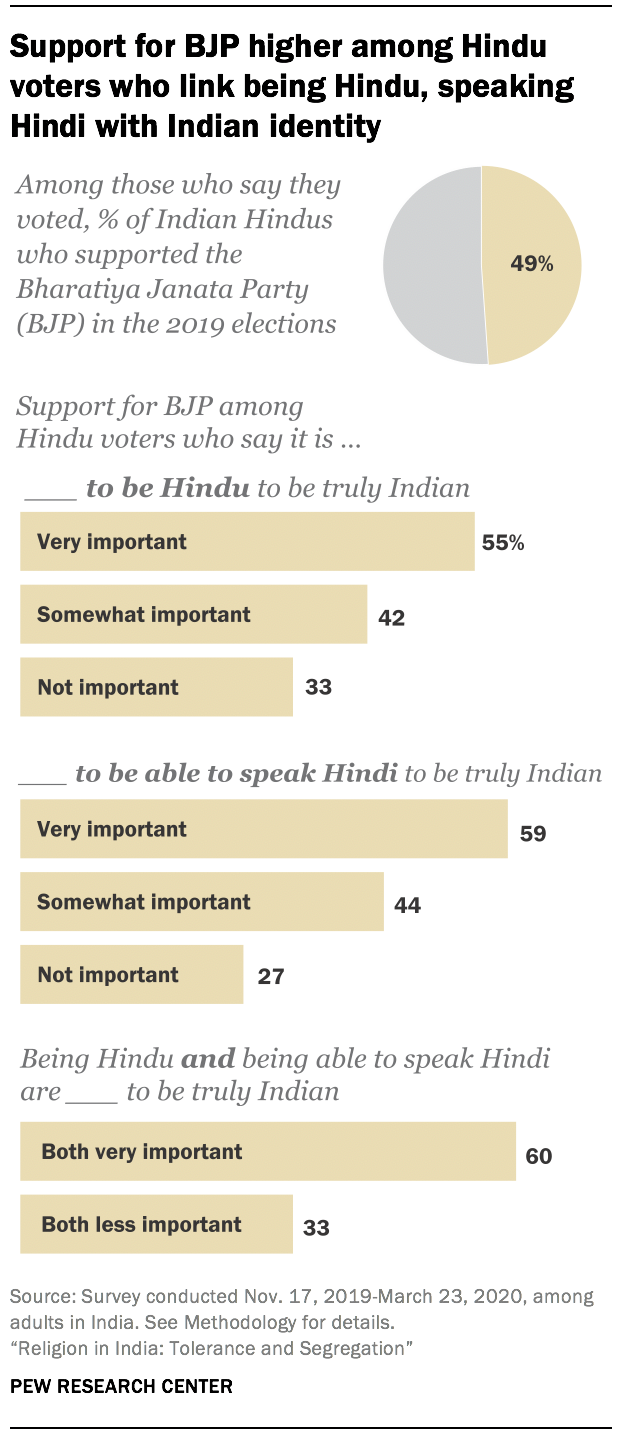
Most Hindus (59%) also link Indian identity with being able to speak Hindi – i of dozens of languages that are widely spoken in India. And these ii dimensions of national identity – being able to speak Hindi and being a Hindu – are closely continued. Amidst Hindus who say it is very important to be Hindu to be truly Indian, fully lxxx% as well say information technology is very important to speak Hindi to be truly Indian.
The BJP's appeal is greater among Hindus who closely acquaintance their religious identity and the Hindi language with beingness "truly Indian." In the 2019 national elections, 60% of Hindu voters who retrieve it is very of import to be Hindu and to speak Hindi to be truly Indian cast their vote for the BJP, compared with only a third among Hindu voters who feel less strongly nearly both these aspects of national identity.
Overall, among those who voted in the 2019 elections, 3-in-x Hindus have all three positions: saying it is very important to exist Hindu to be truly Indian; maxim the same nearly speaking Hindi; and casting their election for the BJP.
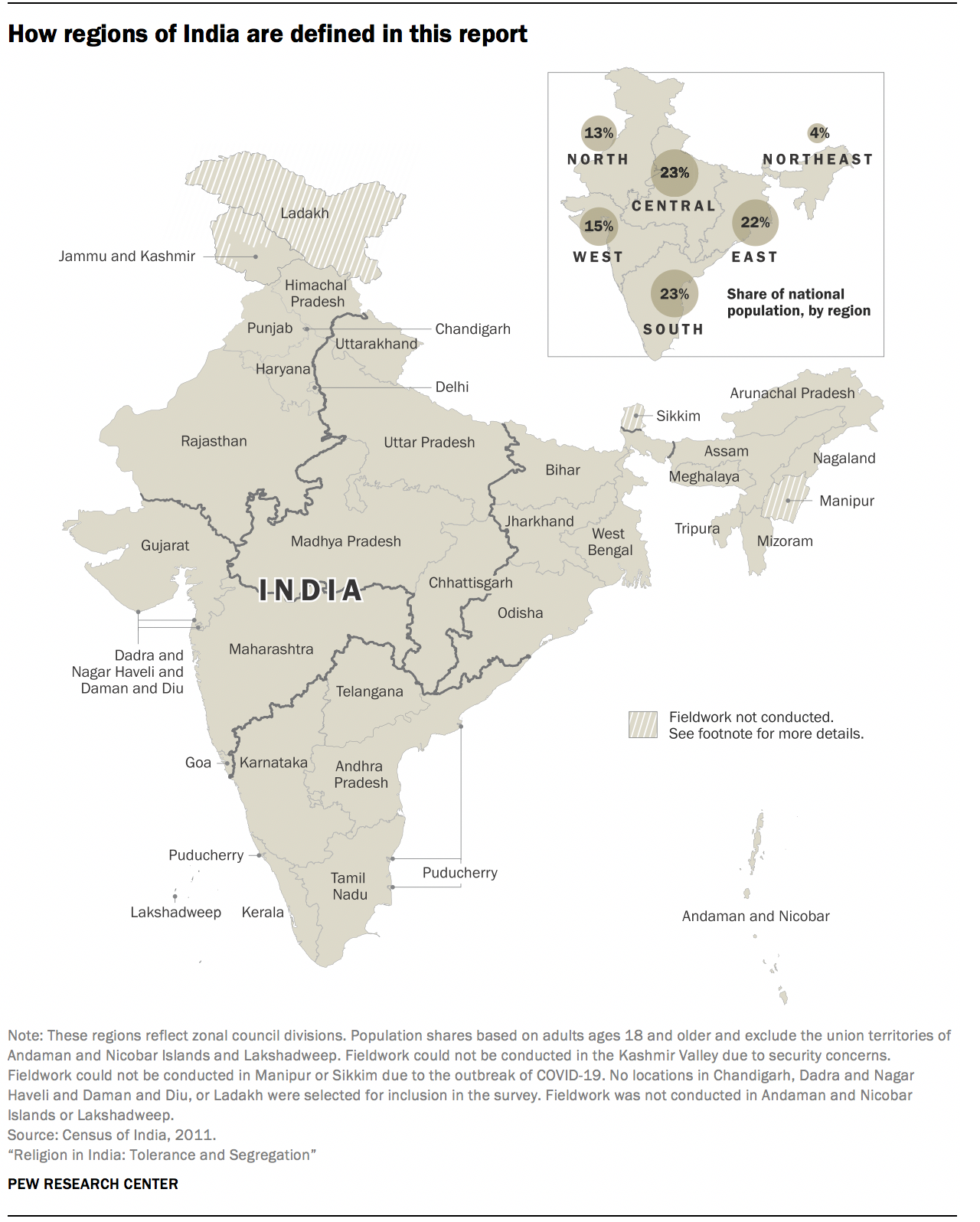
These views are considerably more than mutual among Hindus in the largely Hindi-speaking Northern and Central regions of the land, where roughly half of all Hindu voters fall into this category, compared with simply v% in the S.
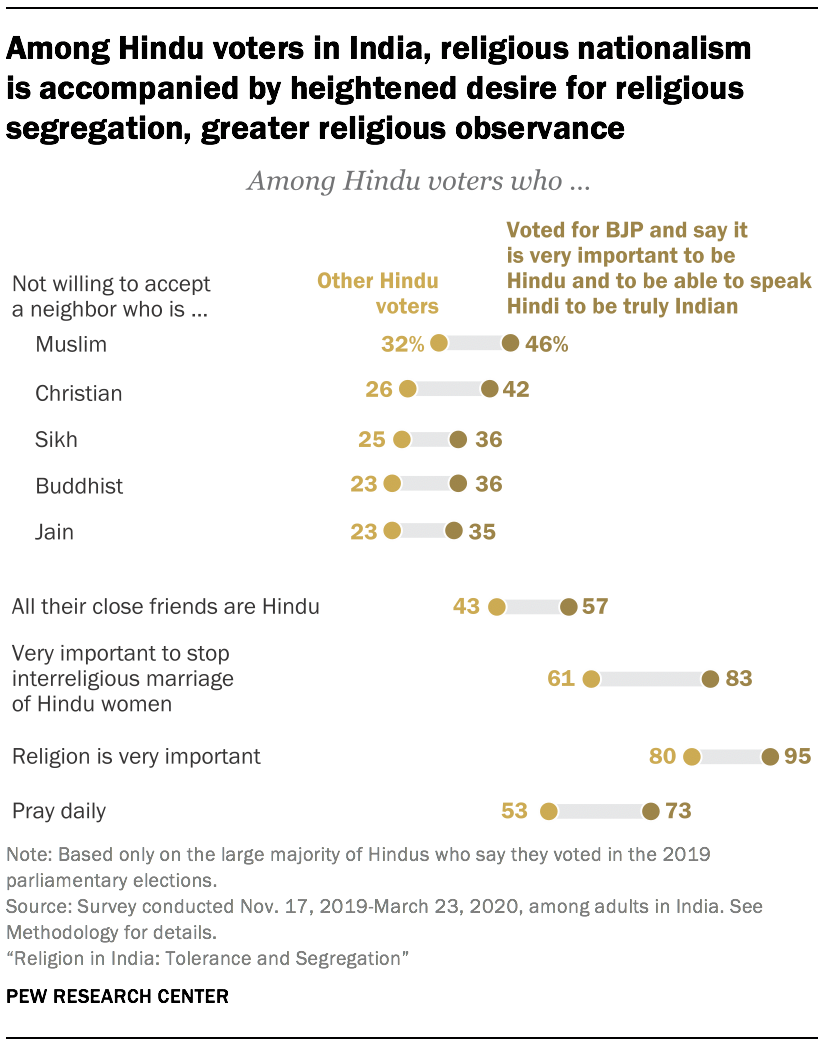
Whether Hindus who see all 3 of these criteria authorize as "Hindu nationalists" may be debated, but they practice limited a heightened desire for maintaining articulate lines betwixt Hindus and other religious groups when it comes to whom they marry, who their friends are and whom they alive among. For example, among Hindu BJP voters who link national identity with both religion and language, 83% say it is very important to stop Hindu women from marrying into another religion, compared with 61% among other Hindu voters.
This group also tends to be more religiously observant: 95% say religion is very important in their lives, and roughly three-quarters say they pray daily (73%). By comparison, among other Hindu voters, a smaller majority (80%) say religion is very important in their lives, and about half (53%) pray daily.
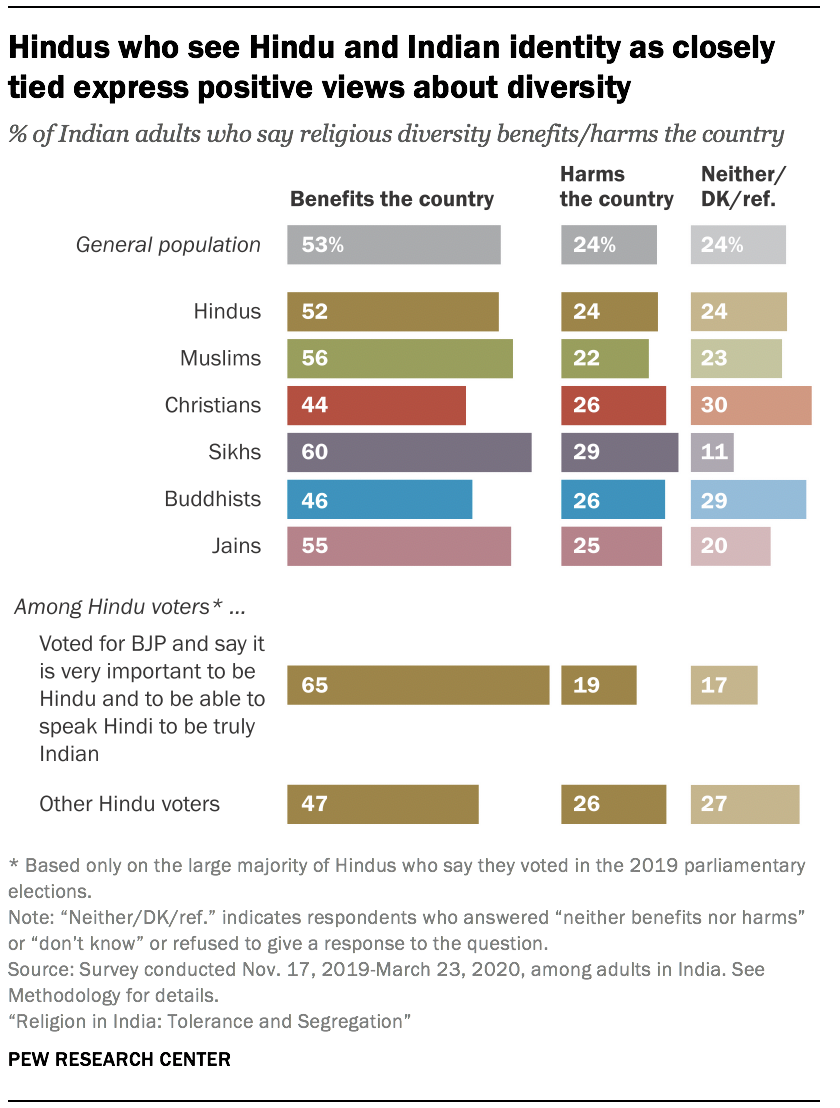
Even though Hindu BJP voters who link national identity with religion and linguistic communication are more than inclined to support a religiously segregated Republic of india, they besides aremorelikely than other Hindu voters to express positive opinions about India's religious diversity. Nearly two-thirds (65%) of this group – Hindus who say that being a Hindu and being able to speak Hindi are very of import to be truly Indianandwho voted for the BJP in 2019 – say religious diversity benefits India, compared with about one-half (47%) of other Hindu voters.
This finding suggests that for many Hindus, there is no contradiction between valuing religious variety (at least in principle) and feeling that Hindus are somehow more than authentically Indian than fellow citizens who follow other religions.
Among Indians overall, there is no overwhelming consensus on the benefits of religious diversity. On remainder, more Indians see diversity as a benefit than view information technology as a liability for their country: Roughly one-half (53%) of Indian adults say India's religious diversity benefits the country, while about a quarter (24%) meet diverseness equally harmful, with similar figures among both Hindus and Muslims. But 24% of Indians do not take a clear position either way – they say variety neither benefits nor harms the land, or they turn down to answer the question. (Encounter Affiliate 2 for a discussion of attitudes toward diversity.)
India'due south Muslims express pride in being Indian while identifying communal tensions, desiring segregation
Bharat'southward Muslim community, the second-largest religious group in the land, historically has had a complicated human relationship with the Hindu majority. The two communities generally have lived peacefully adjacent for centuries, but their shared history likewise is checkered by ceremonious unrest and violence. Most recently, while the survey was beingness conducted, demonstrations bankrupt out in parts of New Delhi and elsewhere over the government's new citizenship law, which creates an expedited path to citizenship for immigrants from some neighboring countries – but non Muslims.
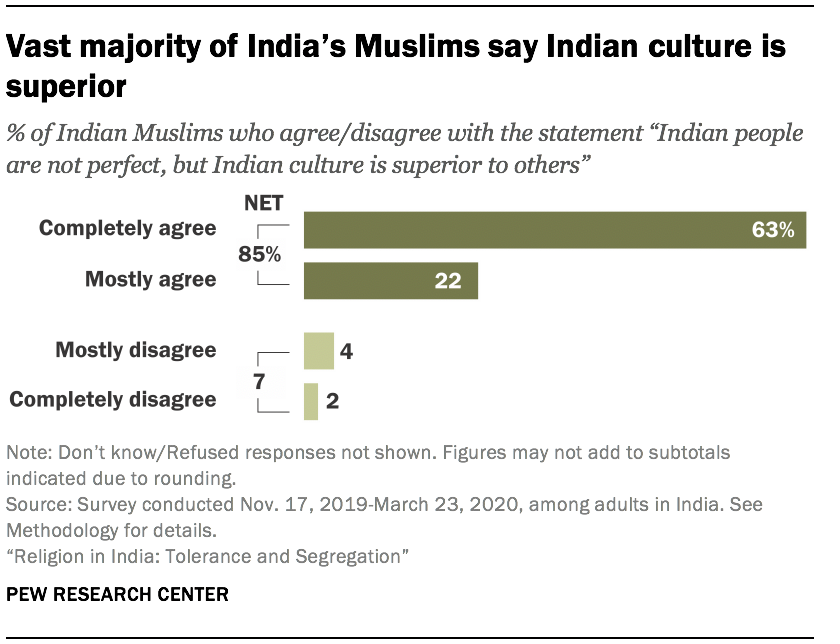
Today, Republic of india'due south Muslims almost unanimously say they are very proud to be Indian (95%), and they express great enthusiasm for Indian culture: 85% concord with the argument that "Indian people are not perfect, but Indian culture is superior to others."
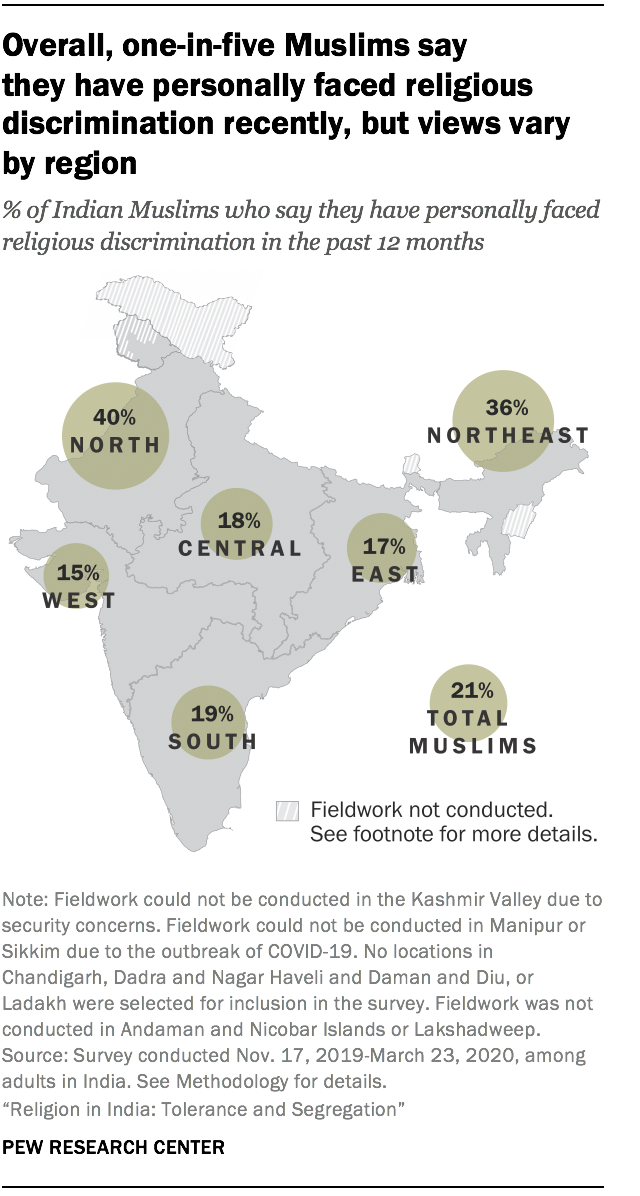
Relatively few Muslims say their community faces "a lot" of bigotry in India (24%). In fact, the share of Muslims who see widespread discrimination against their community is similar to the share of Hindus who say Hindus face widespread religious bigotry in India (21%). (Come across Chapter 1 for a word of attitudes on religious bigotry.)
But personal experiences with bigotry amongst Muslims vary quite a bit regionally. Amongst Muslims in the North, 40% say they personally have faced religious discrimination in the terminal 12 months – much college levels than reported in most other regions.
In addition, near Muslims across the land (65%), forth with an identical share of Hindus (65%), see communal violence every bit a very big national problem. (See Chapter one for a discussion of Indians' attitudes toward national issues.)
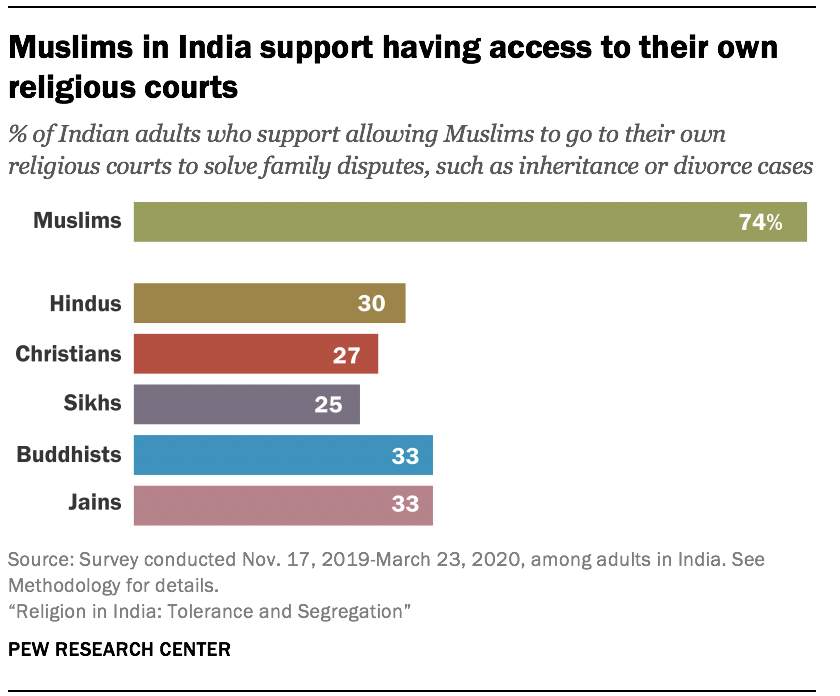
Like Hindus, Muslims adopt to alive religiously segregated lives – not just when it comes to wedlock and friendships, but also in some elements of public life. In detail, three-quarters of Muslims in Republic of india (74%) back up having access to the existing system of Islamic courts, which handle family disputes (such as inheritance or divorce cases), in addition to the secular court system.
Muslims' want for religious segregation does not preclude tolerance of other groups – once more similar to the pattern seen among Hindus. Indeed, a majority of Muslims who favor split up religious courts for their community say religious diversity benefits India (59%), compared with somewhat fewer of those who oppose religious courts for Muslims (50%).
Since 1937, India'south Muslims have had the option of resolving family unit and inheritance-related cases in officially recognized Islamic courts, known as dar-ul-qaza. These courts are overseen by religious magistrates known every bit qazi and operate nether Shariah principles. For example, while the rules of inheritance for most Indians are governed by the Indian Succession Act of 1925 and the Hindu Succession Deed of 1956 (amended in 2005), Islamic inheritance practices differ in some ways, including who tin be considered an heir and how much of the deceased person's holding they tin inherit. India's inheritance laws also take into business relationship the differing traditions of other religious communities, such as Hindus and Christians, only their cases are handled in secular courts. Simply the Muslim customs has the option of having cases tried past a separate system of family courts. The decisions of the religious courts, all the same, are non legally bounden, and the parties involved have the option of taking their case to secular courts if they are not satisfied with the decision of the religious court.
Every bit of 2021, at that place are roughly 70 dar-ul-qaza in Republic of india. About are in united states of america of Maharashtra and Uttar Pradesh. Goa is the just state that does not recognize rulings past these courts, enforcing its own uniform civil code instead. Dar-ul-qaza are overseen by the All India Muslim Personal Law Board.
While these courts tin can grant divorces amidst Muslims, they are prohibited from approving divorces initiated through the practice known as triple talaq, in which a Muslim man instantly divorces his wife by saying the Arabic/Urdu word "talaq" (meaning "divorce") three times. This do was deemed unconstitutional by the Indian Supreme Court in 2017 and formally outlawed past the Lok Sabha, the lower house of India'southward Parliament, in 2019.1
Recent debates have emerged effectually Islamic courts. Some Indians have expressed concern that the rise of dar-ul-qaza could undermine the Indian judiciary, because a subset of the population is not bound to the aforementioned laws as anybody else. Others take argued that the rulings of Islamic courts are peculiarly unfair to women, although the prohibition of triple talaq may temper some of these criticisms. In its 2019 political manifesto, the BJP proclaimed a desire to create a national Uniform Civil Code, saying it would increase gender equality.
Some Indian commentators have voiced opposition to Islamic courts forth with more broadly negative sentiments against Muslims, describing the rising numbers of dar-ul-qaza every bit the "Talibanization" of India, for example.
On the other mitt, Muslim scholars accept dedicated the dar-ul-qaza, saying they expedite justice considering family disputes that would otherwise clog Republic of india's courts can exist handled separately, allowing the secular courts to focus their attention on other concerns.
Since 2018, the Hindu nationalist party Hindu Mahasabha (which does not hold any seats in Parliament) has tried to ready Hindu religious courts, known every bit Hindutva courts, aiming to play a office similar to dar-ul-qaza, but for the bulk Hindu community. None of these courts have been recognized by the Indian government, and their rulings are not considered legally binding.
Muslims, Hindus diverge over legacy of Partition
The seminal event in the modern history of Hindu-Muslim relations in the region was the partitioning of the subcontinent into Hindu-majority India and Muslim-majority Pakistan at the terminate of the British colonial period in 1947. Partition remains one of the largest movements of people beyond borders in recorded history, and in both countries the carving of new borders was accompanied past violence, rioting and looting.
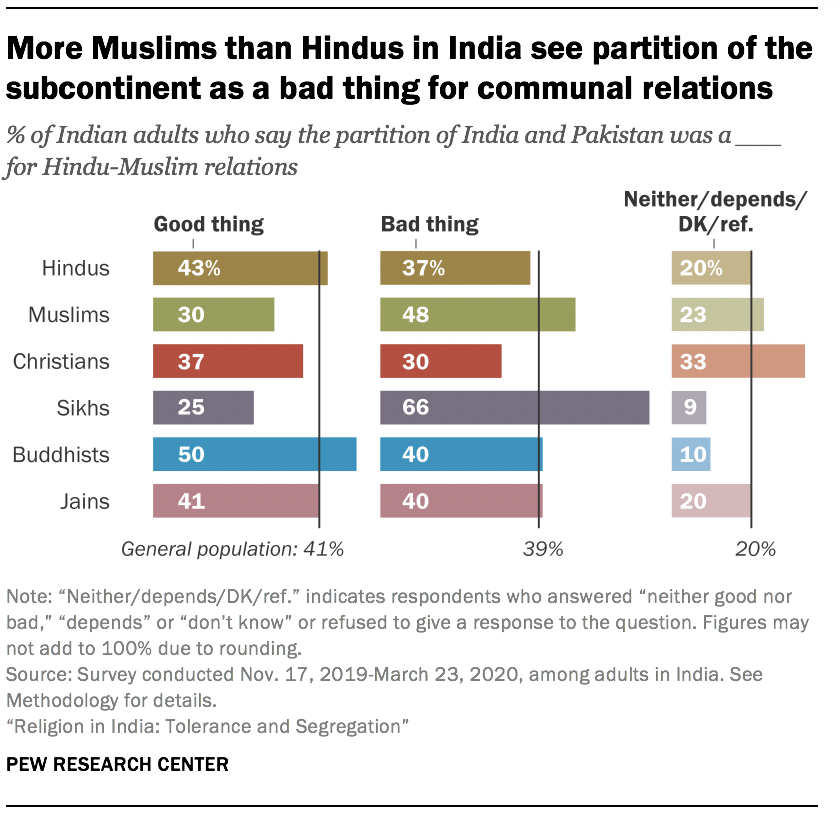
More than than 7 decades later on, the predominant view among Indian Muslims is that the division of the subcontinent was "a bad thing" for Hindu-Muslim relations. Nearly one-half of Muslims say Partition hurt communal relations with Hindus (48%), while fewer say it was a good matter for Hindu-Muslim relations (xxx%). Among Muslims who prefer more than religious segregation – that is, who say they would not accept a person of a unlike faith as a neighbor – an even higher share (sixty%) say Partition was a bad thing for Hindu-Muslim relations.
Sikhs, whose homeland of Punjab was split by Partition, are even more likely than Muslims to say Partition was a bad thing for Hindu-Muslim relations: Ii-thirds of Sikhs (66%) take this position. And Sikhs ages 60 and older, whose parents nigh probable lived through Segmentation, are more inclined than younger Sikhs to say the partition of the country was bad for communal relations (74% vs. 64%).
While Sikhs and Muslims are more likely to say Segmentation was a bad thing than a good thing, Hindus lean in the opposite management: 43% of Hindus say Partition was beneficial for Hindu-Muslim relations, while 37% see it as a bad thing.
Context for the survey
Interviews were conducted later on the conclusion of the 2019 national parliamentary elections and after the revocation of Jammu and Kashmir's special status under the Indian Constitution. In December 2019, protests confronting the country'south new citizenship law broke out in several regions.
Fieldwork could not be conducted in the Kashmir Valley and a few districts elsewhere due to security concerns. These locations include some heavily Muslim areas, which is part of the reason why Muslims make up 11% of the survey's full sample, while Bharat's adult population is roughly 13% Muslim, co-ordinate to the most contempo census data that is publicly available, from 2011. In improver, it is possible that in another parts of the state, interreligious tensions over the new citizenship law may accept slightly depressed participation in the survey by potential Muslim respondents.
All the same, the survey's estimates of religious behavior, behaviors and attitudes can be reported with a high degree of confidence for Republic of india's total population, because the number of people living in the excluded areas (Manipur, Sikkim, the Kashmir Valley and a few other districts) is not large plenty to affect the overall results at the national level. Most 98% of Bharat'due south total population had a chance of beingness selected for this survey.
Greater caution is warranted when looking at India's Muslims separately, as a distinct population. The survey cannot speak to the experiences and views of Kashmiri Muslims. Nonetheless, the survey does represent the beliefs, behaviors and attitudes of around 95% of Republic of india's overall Muslim population.
These are amongst the fundamental findings of a Pew Research Center survey conducted face-to-face nationally among 29,999 Indian adults. Local interviewers administered the survey betwixt November. 17, 2019, and March 23, 2020, in 17 languages. The survey covered all states and union territories of Republic of india, with the exceptions of Manipur and Sikkim, where the rapidly developing COVID-19 situation prevented fieldwork from starting in the jump of 2020, and the remote territories of the Andaman and Nicobar Islands and Lakshadweep; these areas are home to near a quarter of 1% of the Indian population. The spousal relationship territory of Jammu and Kashmir was covered by the survey, though no fieldwork was conducted in the Kashmir region itself due to security concerns.
This study, funded by The Pew Charitable Trusts and the John Templeton Foundation, is part of a larger effort by Pew Research Middle to understand religious alter and its impact on societies around the globe. The Center previously has conducted religion-focused surveys across sub-Saharan Africa; the Middle East-North Africa region and many other countries with large Muslim populations; Latin America; Israel; Central and Eastern Europe; Western Europe; and the United States.
The rest of this Overview covers attitudes on five broad topics: caste and discrimination; religious conversion; religious observances and beliefs; how people define their religious identity, including what kind of behavior is considered acceptable to be a Hindu or a Muslim; and the connection between economic development and religious observance.
Caste is another dividing line in Indian society, and non just amid Hindus
Religion is not the simply fault line in Indian lodge. In some regions of the country, meaning shares of people perceive widespread, degree-based discrimination.
The caste system is an ancient social bureaucracy based on occupation and economic condition. People are built-in into a particular caste and tend to keep many aspects of their social life within its boundaries, including whom they ally. Even though the system'southward origins are in historical Hindu writings, today Indians nearly universally place with a caste, regardless of whether they are Hindu, Muslim, Christian, Sikh, Buddhist or Jain.
Overall, the bulk of Indian adults say they are a fellow member of a Scheduled Caste (SC) – oftentimes referred to as Dalits (25%) – Scheduled Tribe (ST) (9%) or Other Backward Class (OBC) (35%).two
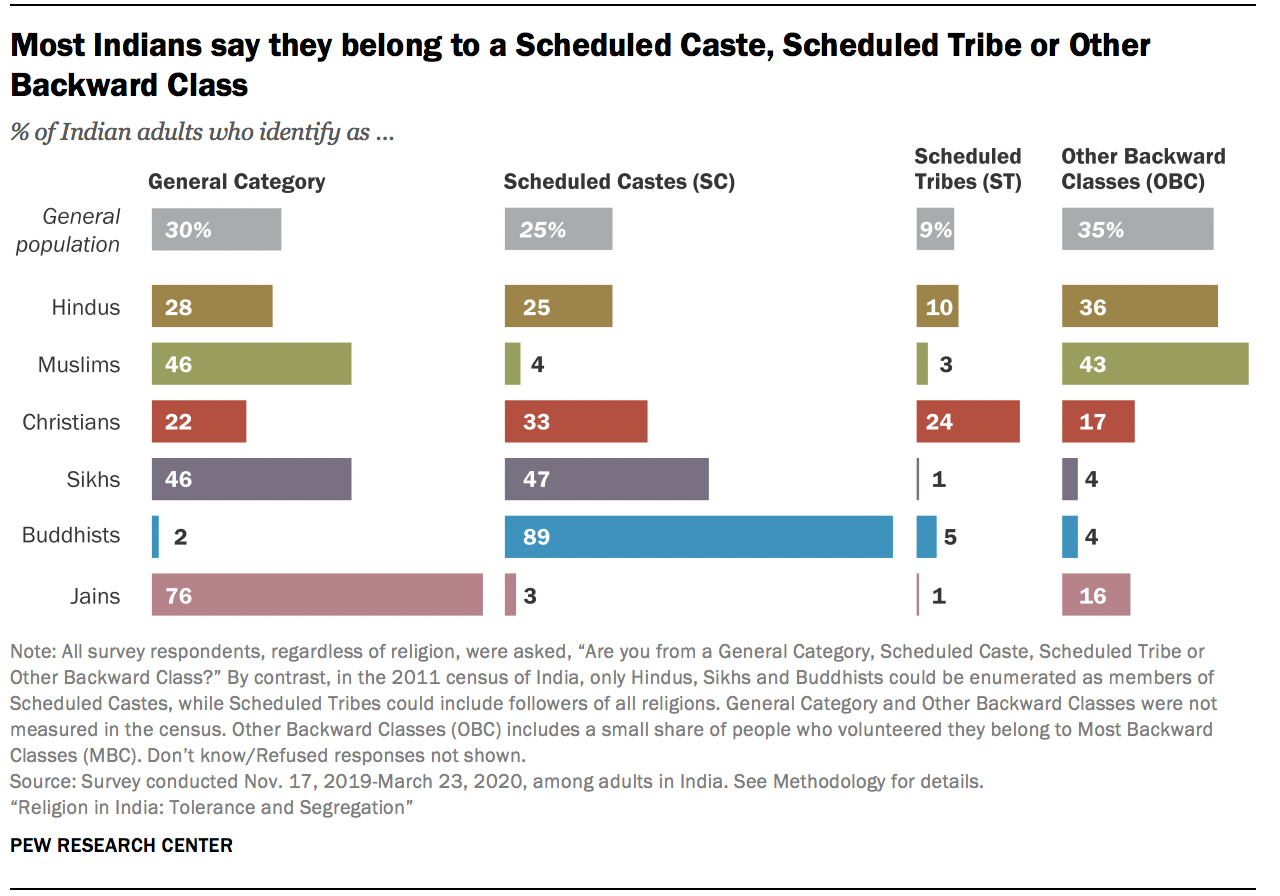
Buddhists in India nearly universally identify themselves in these categories, including 89% who are Dalits (sometimes referred to past the debasing term "untouchables").
Members of SC/ST/OBC groups traditionally formed the lower social and economic rungs of Indian society, and historically they have faced discrimination and unequal economic opportunities. The practice of untouchability in India ostracizes members of many of these communities, specially Dalits, although the Indian Constitution prohibits caste-based discrimination, including untouchability, and in recent decades the government has enacted economic advancement policies like reserved seats in universities and government jobs for Dalits, Scheduled Tribes and OBC communities.
Roughly 30% of Indians exercise not belong to these protected groups and are classified as "Full general Category." This includes higher castes such as Brahmins (4%), traditionally the priestly degree. Indeed, each wide category includes several sub-castes – sometimes hundreds – with their ain social and economic hierarchies.
Three-quarters of Jains (76%) identify with General Category castes, as do 46% of both Muslims and Sikhs.
Caste-based bigotry, besides as the regime's efforts to compensate for past bigotry, are politically charged topics in India. But the survey finds that most Indians do non perceive widespread caste-based bigotry. Just ane-in-v Indians say there is a lot of discrimination against members of SCs, while 19% say at that place is a lot of discrimination confronting STs and somewhat fewer (16%) encounter loftier levels of discrimination against OBCs. Members of Scheduled Castes and Scheduled Tribes are slightly more probable than others to perceive widespread discrimination against their two groups. Nevertheless, big majorities of people in these categories do non think they face up a lot of bigotry.
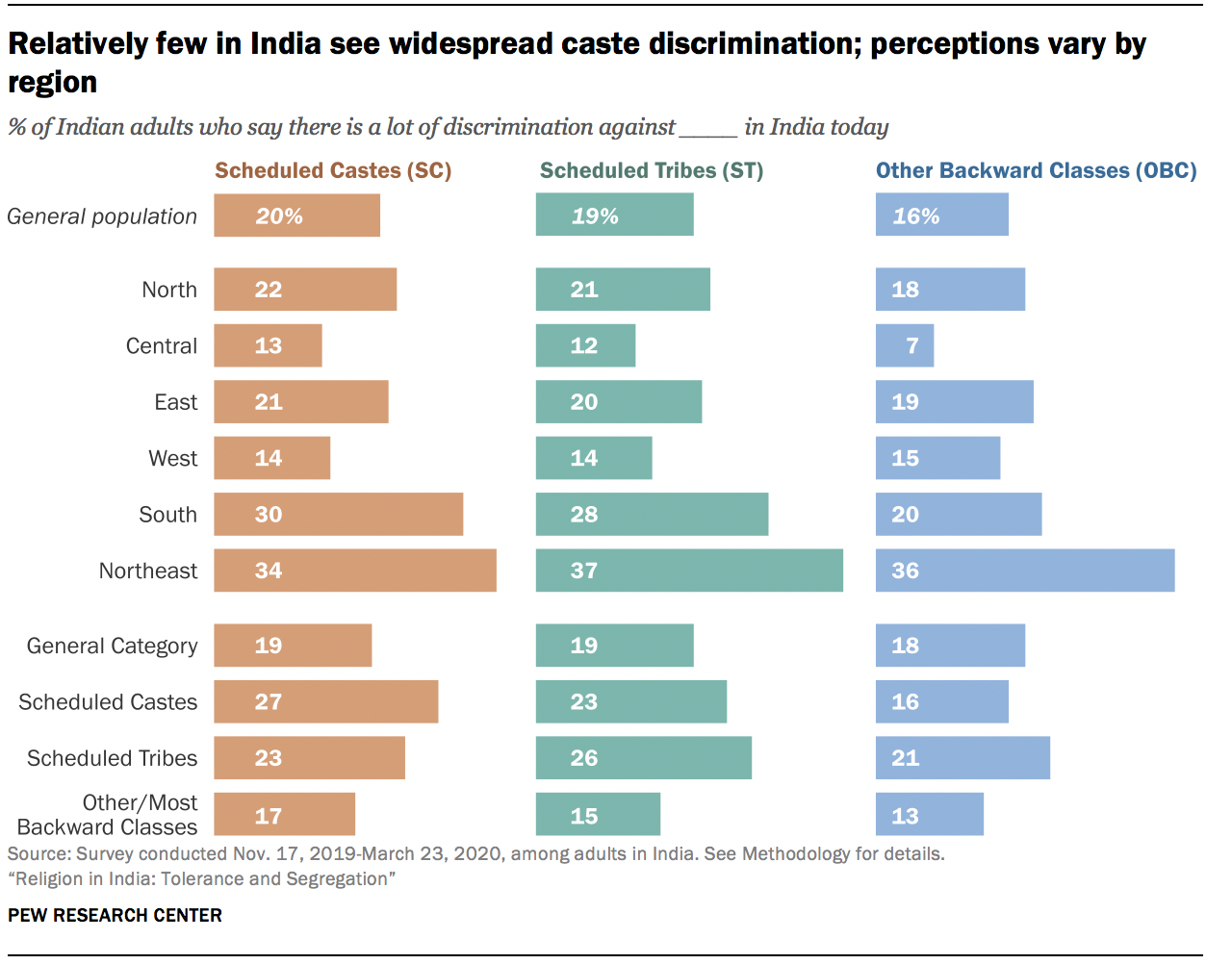
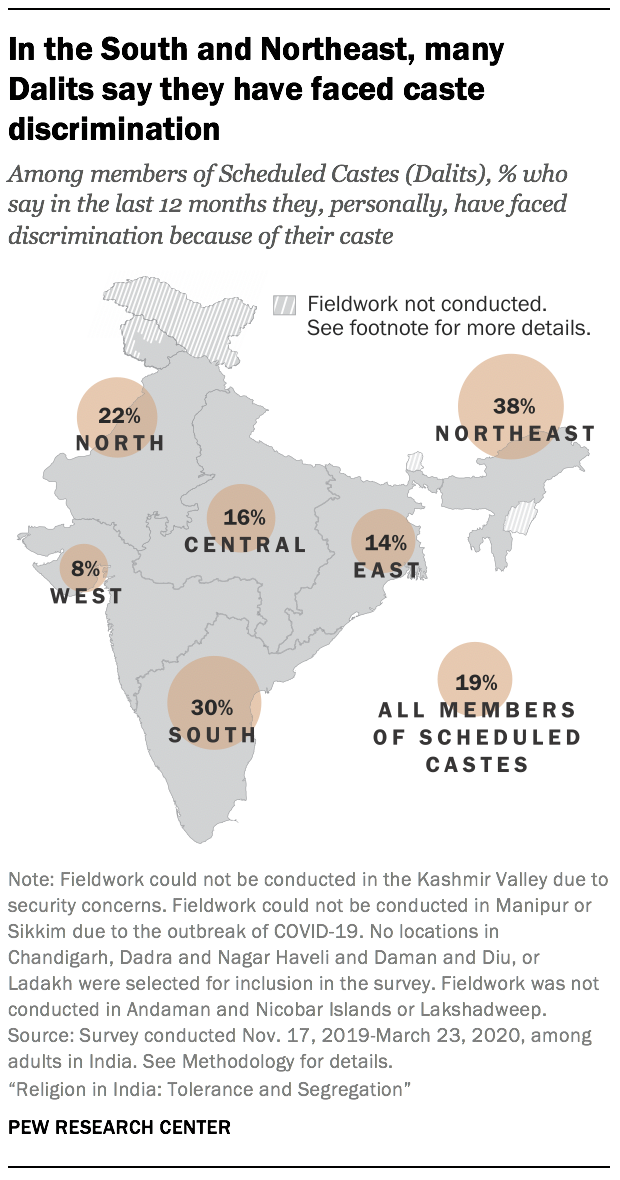
These attitudes vary past region, however. Among Southern Indians, for example, 30% see widespread discrimination against Dalits, compared with 13% in the Central role of the country. And amidst the Dalit community in the Due south, even more than (43%) say their community faces a lot of discrimination, compared with 27% amidst Southern Indians in the General Category who say the Dalit community faces widespread discrimination in Republic of india.
A higher share of Dalits in the South and Northeast than elsewhere in the country say they, personally, have faced discrimination in the terminal 12 months considering of their caste: 30% of Dalits in the S say this, equally do 38% in the Northeast.
Although caste bigotry may not be perceived every bit widespread nationally, caste remains a stiff gene in Indian society. Most Indians from other castes say they would be willing to have someone belonging to a Scheduled Caste as a neighbor (72%). But a similarly large majority of Indians overall (70%) say that about or all of their close friends share their caste. And Indians tend to object to marriages across caste lines, much as they object to interreligious marriages.3
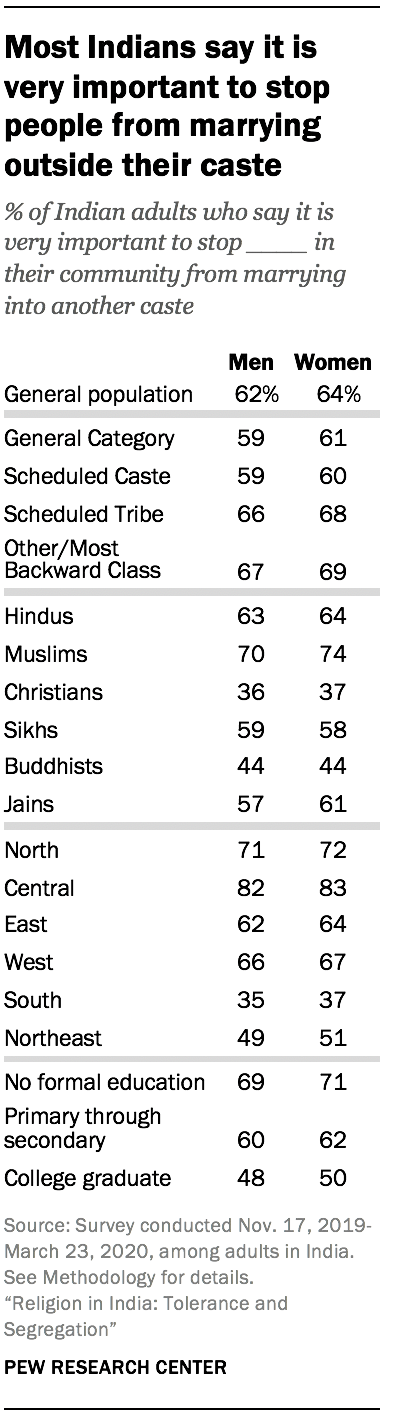
Overall, 64% of Indians say it is very important to terminate women in their community from marrying into other castes, and nearly the same share (62%) say it is very of import to end men in their community from marrying into other castes. These figures vary just modestly across members of unlike castes. For case, virtually identical shares of Dalits and members of General Category castes say stopping inter-caste marriages is very important.
Majorities of Hindus, Muslims, Sikhs and Jains consider stopping inter-degree marriage of both men and women a high priority. By comparison, fewer Buddhists and Christians say it is very important to terminate such marriages – although for majorities of both groups, stopping people from marrying outside their degree is at least "somewhat" important.
People surveyed in India'due south S and Northeast encounter greater caste discrimination in their communities, and they besides enhance fewer objections to inter-caste marriages than do Indians overall. Meanwhile, college-educated Indians are less likely than those with less education to say stopping inter-caste marriages is a loftier priority. But, fifty-fifty within the nigh highly educated group, roughly half say preventing such marriages is very important. (See Affiliate 4 for more analysis of Indians' views on degree.)
Religious conversion in India
In recent years, conversion of people belonging to lower castes (including Dalits) abroad from Hinduism – a traditionally not-proselytizing faith – to proselytizing religions, especially Christianity, has been a contentious political consequence in India. As of early 2021, nine states take enacted laws against proselytism, and some previous surveys have shown that half of Indians support legal bans on religious conversions.iv
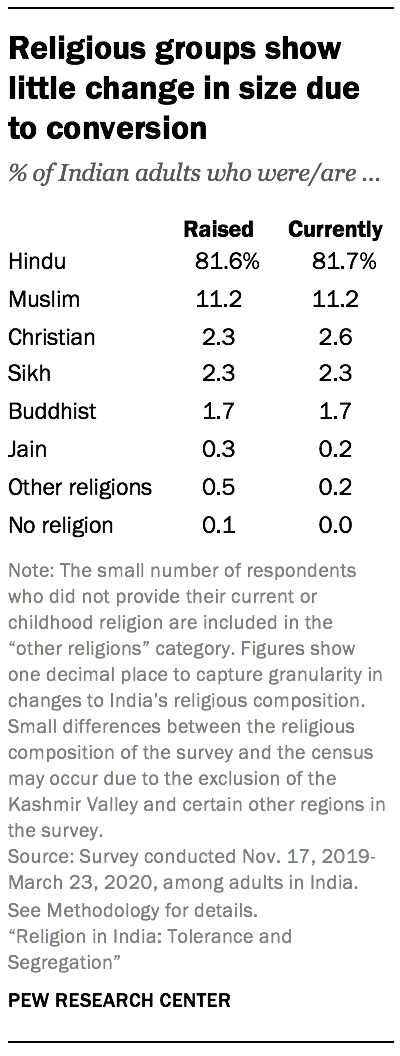
This survey, though, finds that religious switching, or conversion, has a minimal impact on the overall size of India'south religious groups. For example, according to the survey, 82% of Indians say they were raised Hindu, and a almost identical share say they are currently Hindu, showing no net losses for the group through conversion to other religions. Other groups display similar levels of stability.
Changes in India'southward religious landscape over time are largely a issue of differences in fertility rates among religious groups, not conversion.
Respondents were asked ii separate questions to measure religious switching: "What is your present religion, if any?" and, later in the survey, "In what religion were you raised, if any?" Overall, 98% of respondents give the same answer to both these questions.
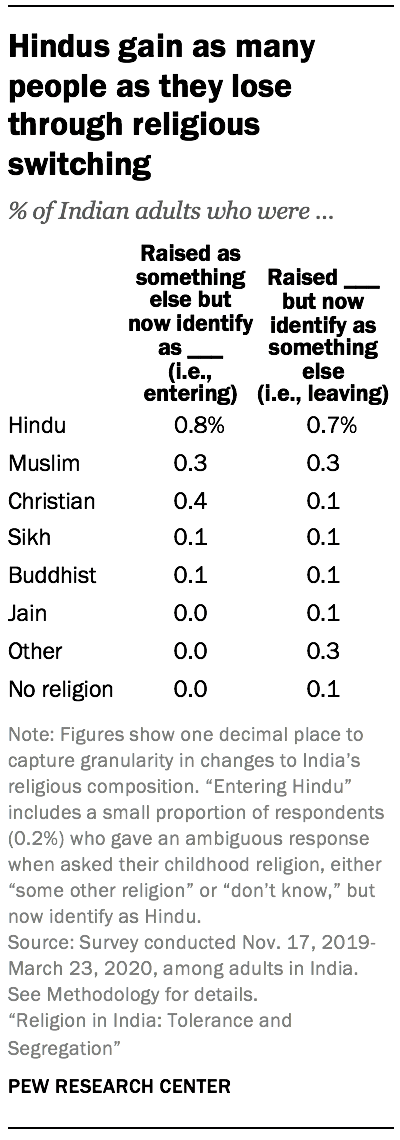
An overall pattern of stability in the share of religious groups is accompanied by petty net gain from movement into, or out of, well-nigh religious groups. Amid Hindus, for case, any conversion out of the group is matched by conversion into the grouping: 0.seven% of respondents say they were raised Hindu but at present identify as something else, and although Hindu texts and traditions practice not agree on any formal process for conversion into the organized religion, roughly the same share (0.viii%) say they werenon raised Hindu simply now identify as Hindu.5 Nigh of these new followers of Hinduism are married to Hindus.
Similarly, 0.3% of respondents have left Islam since childhood, matched past an identical share who say they were raised in other religions (or had no childhood religion) and take since go Muslim.
For Christians, withal, in that location are some cyberspace gains from conversion: 0.iv% of survey respondents are former Hindus who now identify every bit Christian, while 0.one% are former Christians.
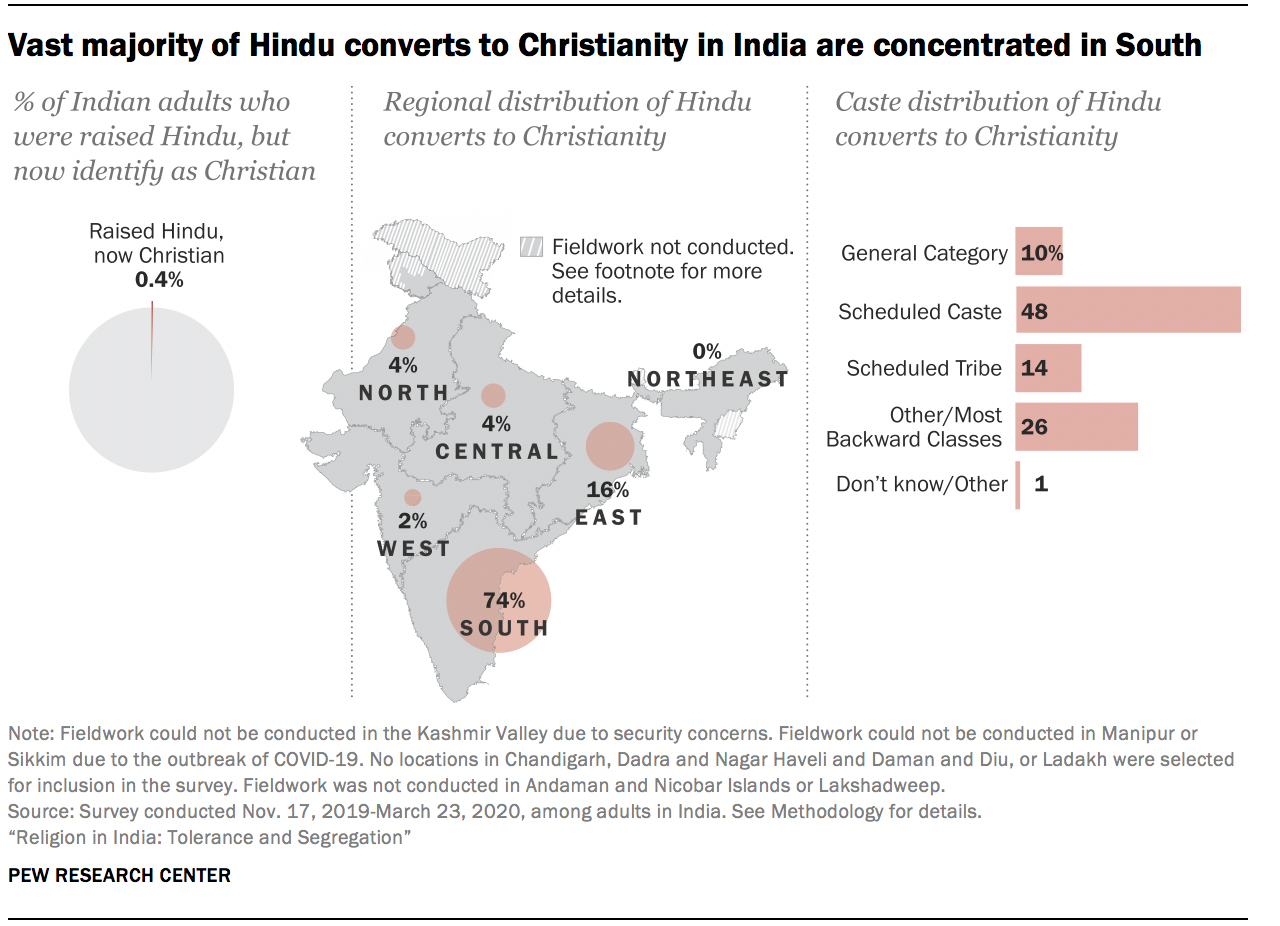
3-quarters of Bharat's Hindu converts to Christianity (74%) are full-bodied in the Southern role of the state – the region with the largest Christian population. As a consequence, the Christian population of the Due south shows a slight increment within the lifetime of survey respondents: 6% of Southern Indians say they were raised Christian, while vii% say they are currently Christian.
Some Christian converts (16%) reside in the East besides (united states of Bihar, Jharkhand, Odisha and W Bengal); nearly ii-thirds of all Christians in the East (64%) belong to Scheduled Tribes.
Nationally, the vast bulk of quondam Hindus who are now Christian belong to Scheduled Castes (48%), Scheduled Tribes (14%) or Other Backward Classes (26%). And former Hindus are much more likely than the Indian population overall to say there is a lot of discrimination against lower castes in India. For example, nearly one-half of converts to Christianity (47%) say there is a lot of discrimination against Scheduled Castes in India, compared with xx% of the overall population who perceive this level of discrimination confronting Scheduled Castes. Nonetheless, relatively few converts say they, personally, have faced discrimination due to their degree in the last 12 months (12%).
Religion very of import beyond India'due south religious groups
Though their specific practices and behavior may vary, all of Bharat's major religious communities are highly observant by standard measures. For instance, the vast majority of Indians, across all major faiths, say that faith is very of import in their lives. And at least 3-quarters of each major religion's followers say they know a bang-up deal almost their own religion and its practices. For example, 81% of Indian Buddhists claim a great deal of knowledge virtually the Buddhist organized religion and its practices.
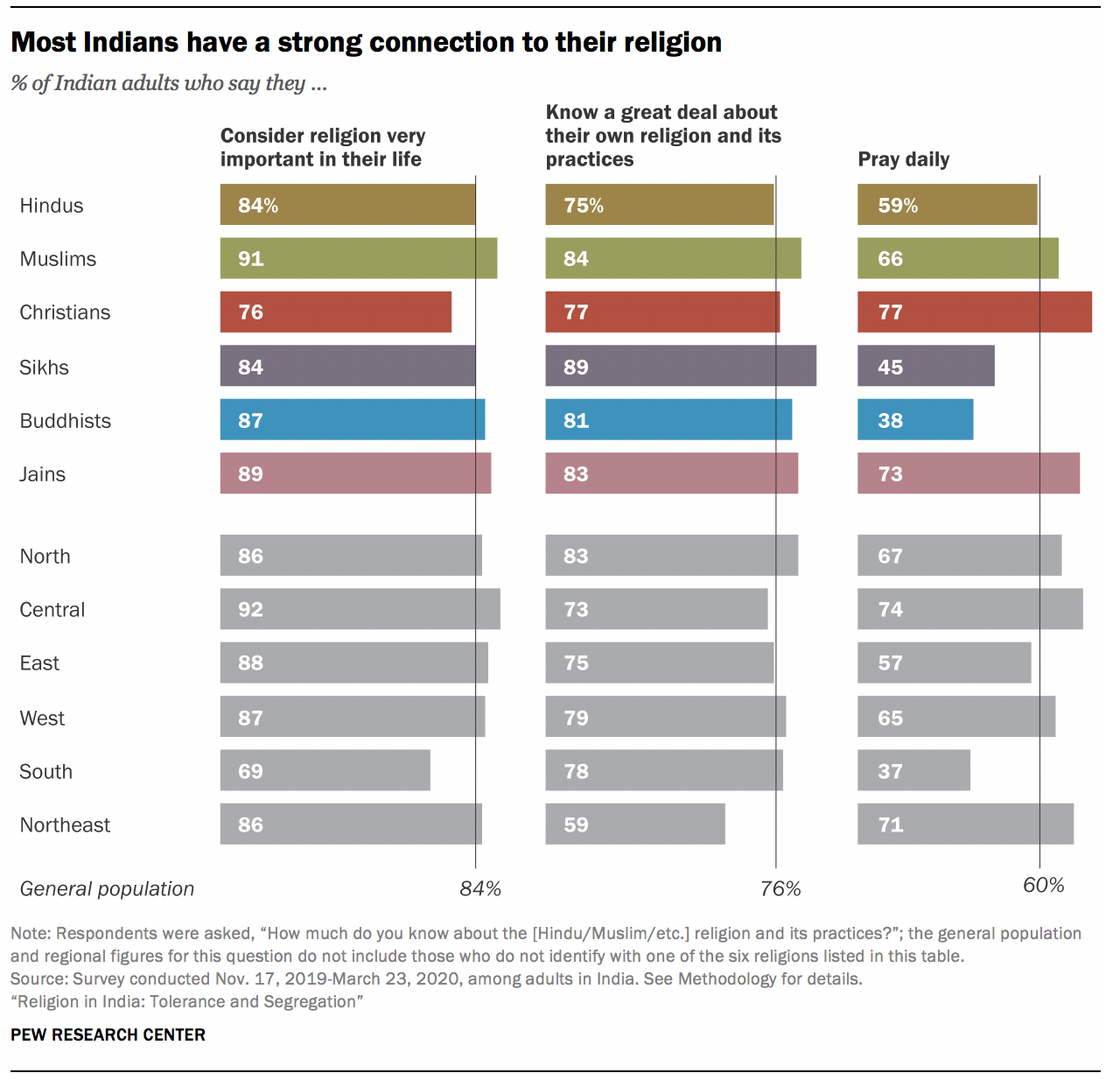
Indian Muslims are slightly more likely than Hindus to consider religion very important in their lives (91% vs. 84%). Muslims besides are modestly more likely than Hindus to say they know a keen deal about their ain religion (84% vs. 75%).
Pregnant portions of each religious group too pray daily, with Christians among the most likely to exercise then (77%) – fifty-fifty though Christians are the to the lowest degree likely of the six groups to say faith is very important in their lives (76%). Almost Hindus and Jains also pray daily (59% and 73%, respectively) and say they perform puja daily (57% and 81%), either at domicile or at a temple.vi
Mostly, younger and older Indians, those with dissimilar educational backgrounds, and men and women are similar in their levels of religious observance. South Indians are the to the lowest degree probable to say faith is very important in their lives (69%), and the Southward is the only region where fewer than half of people report praying daily (37%). While Hindus, Muslims and Christians in the South are all less likely than their counterparts elsewhere in India to say religion is very of import to them, the lower rate of prayer in the South is driven mainly past Hindus: Three-in-ten Southern Hindus report that they pray daily (30%), compared with roughly two-thirds (68%) of Hindus in the residual of the country (see "People in the South differ from residue of the land in their views of faith, national identity" beneath for farther word of religious differences in Southern Republic of india).
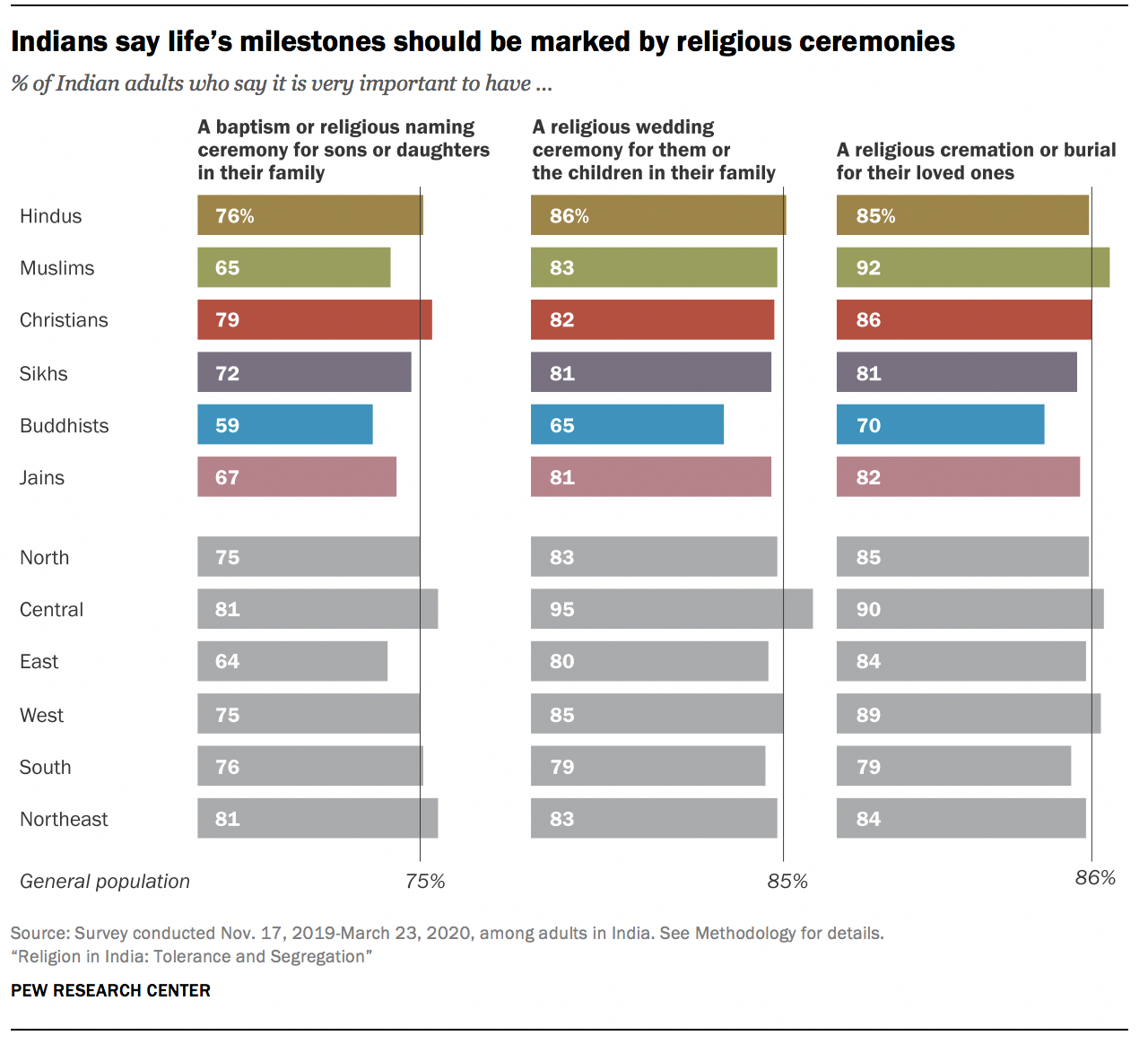
The survey also asked about iii rites of passage: religious ceremonies for nascence (or infancy), marriage and expiry. Members of all of India's major religious communities tend to see these rites as highly important. For example, the vast bulk of Muslims (92%), Christians (86%) and Hindus (85%) say it is very important to have a religious burial or cremation for their loved ones.
The survey too asked virtually practices specific to particular religions, such as whether people have received purification by bathing in holy bodies of water, like the Ganges River, a rite closely associated with Hinduism. Most two-thirds of Hindus have washed this (65%). Most Hindus as well have holy basil (the tulsi establish) in their homes, as practise almost Jains (72% and 62%, respectively). And well-nigh three-quarters of Sikhs follow the Sikh practice of keeping their hair long (76%).
For more on religious practices across India'due south religious groups, see Chapter seven.
Near-universal belief in God, but broad variation in how God is perceived
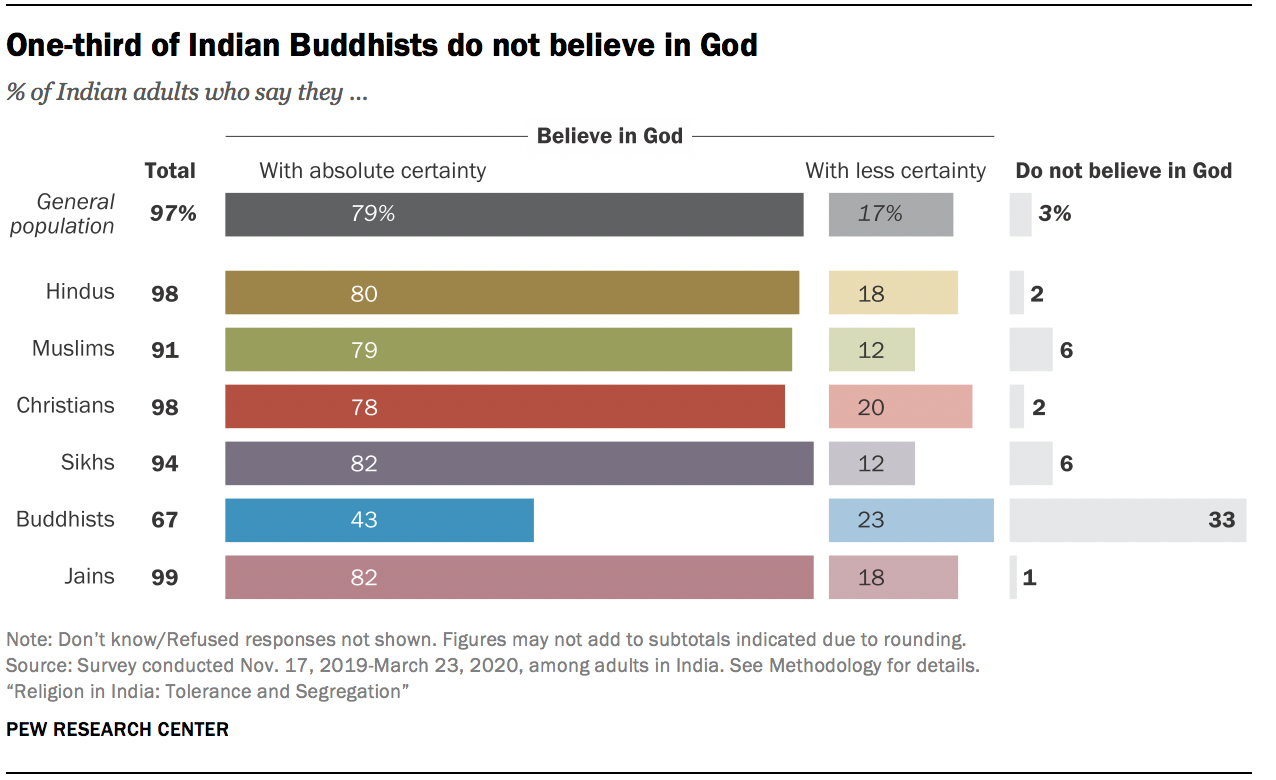
About all Indians say they believe in God (97%), and roughly eighty% of people in most religious groups say they are absolutely certain that God exists. The chief exception is Buddhists, one-third of whom say they practise non believe in God. All the same, among Buddhists who do call up there is a God, most say they are absolutely certain in this belief.
While conventionalities in God is shut to universal in India, the survey finds a wide range of views almost the type of deity or deities that Indians believe in. The prevailing view is that there is one God "with many manifestations" (54%). But about 1-tertiary of the public says simply: "There is only one God" (35%). Far fewer say in that location are many gods (vi%).
Even though Hinduism is sometimes referred to every bit a polytheistic faith, very few Hindus (seven%) have the position that at that place are multiple gods. Instead, the almost common position among Hindus (besides every bit amongst Jains) is that there is "only one God with many manifestations" (61% amid Hindus and 54% amidst Jains).
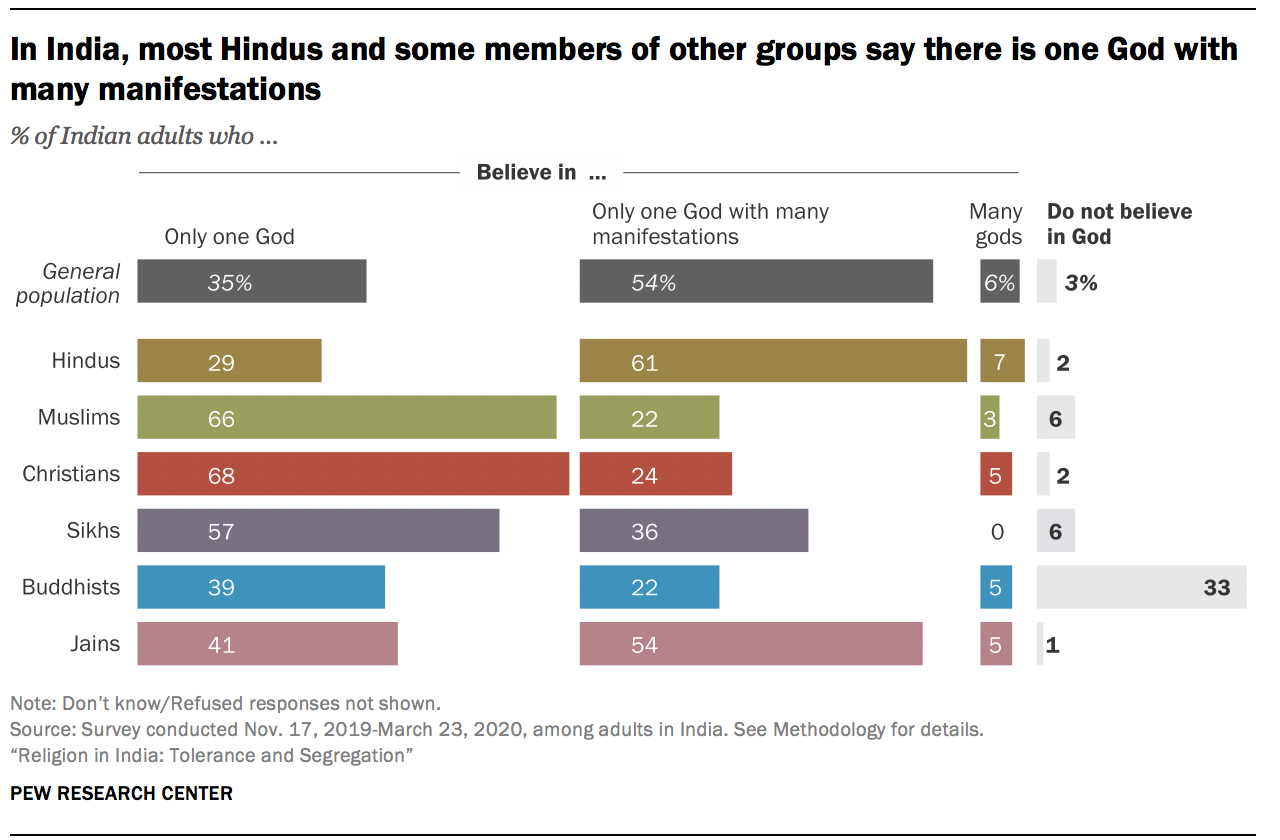
Amid Hindus, those who say religion is very important in their lives are more likely than other Hindus to believe in one God with many manifestations (63% vs. 50%) and less likely to say there are many gods (6% vs. 12%).
By contrast, majorities of Muslims, Christians and Sikhs say in that location is but 1 God. And among Buddhists, the most common response is besides a conventionalities in one God. Among all these groups, still, about ane-in-5 or more than say God has many manifestations, a position closer to their Hindu compatriots' concept of God.
Nigh Hindus feel shut to multiple gods, only Shiva, Hanuman and Ganesha are most pop
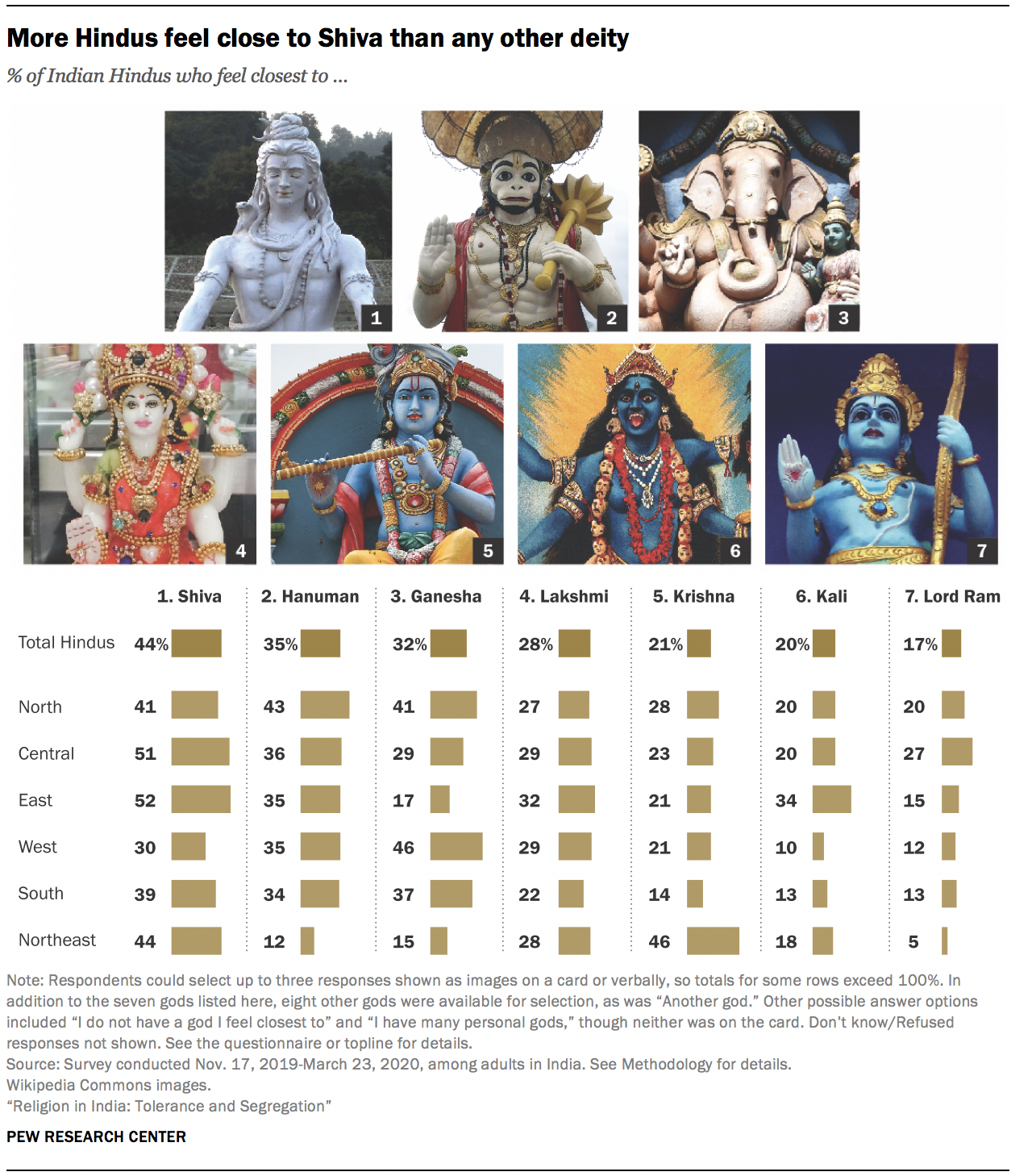
Traditionally, many Hindus have a "personal god," orishta devata:A item god or goddess with whom they experience a personal connection. The survey asked all Indian Hindus who say they believe in God which god they feel closest to – showing them fifteen images of gods on a card equally possible options – and the vast majority of Hindus selected more than one god or indicated that they have many personal gods (84%).seven This is true non only among Hindus who say they believe in many gods (90%) or in i God with many manifestations (87%), simply also amid those who say there is merely i God (82%).
The god that Hindus most commonly feel close to is Shiva (44%). In add-on, almost one-3rd of Hindus feel close to Hanuman or Ganesha (35% and 32%, respectively).
There is corking regional variation in how close India's Hindus experience to some gods. For example, 46% of Hindus in India'due south West feel close to Ganesha, merely only 15% experience this way in the Northeast. And 46% of Hindus in the Northeast feel close to Krishna, while just 14% in the South say the same.
Feelings of closeness for Lord Ram are especially strong in the Central region (27%), which includes what Hindus claim is his ancient birthplace, Ayodhya. The location in Ayodhya where many Hindus believe Ram was born has been a source of controversy: Hindu mobs demolished a mosque on the site in 1992, claiming that a Hindu temple originally existed at that place. In 2019, the Indian Supreme Court ruled that the demolished mosque had been built on tiptop of a preexisting non-Islamic structure and that the land should be given to Hindus to build a temple, with another location in the area given to the Muslim customs to build a new mosque. (For additional findings on conventionalities in God, come across Chapter 12.)
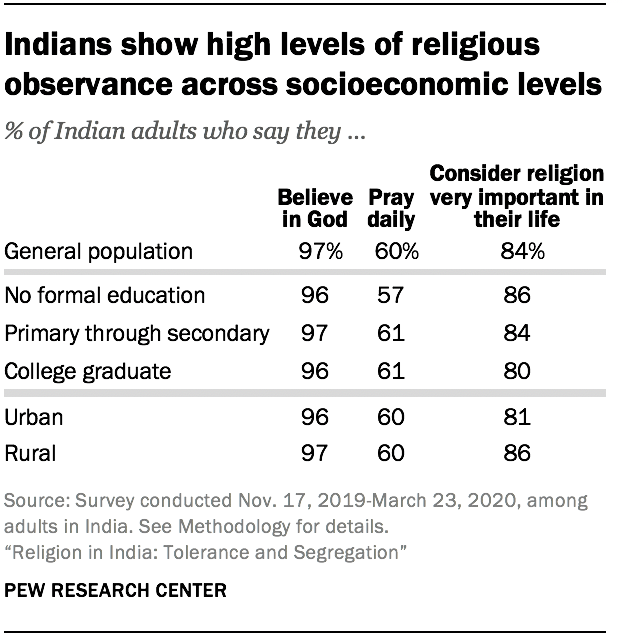
A prominent theory in the social sciences hypothesizes that every bit countries accelerate economically, their populations tend to become less religious, oft leading to wider social change. Known as "secularization theory," information technology particularly reflects the experience of Western European countries from the end of World State of war Ii to the present.
Despite rapid economic growth, Bharat's population so far shows few, if any, signs of losing its religion. For instance, both the Indian demography and the new survey detect well-nigh no growth in the minuscule share of people who claim no religious identity. And religion is prominent in the lives of Indians regardless of their socioeconomic status. Generally, across the land, there is lilliputian difference in personal religious observance between urban and rural residents or between those who are college educated versus those who are not. Overwhelming shares among all these groups say that religion is very important in their lives, that they pray regularly and that they believe in God.
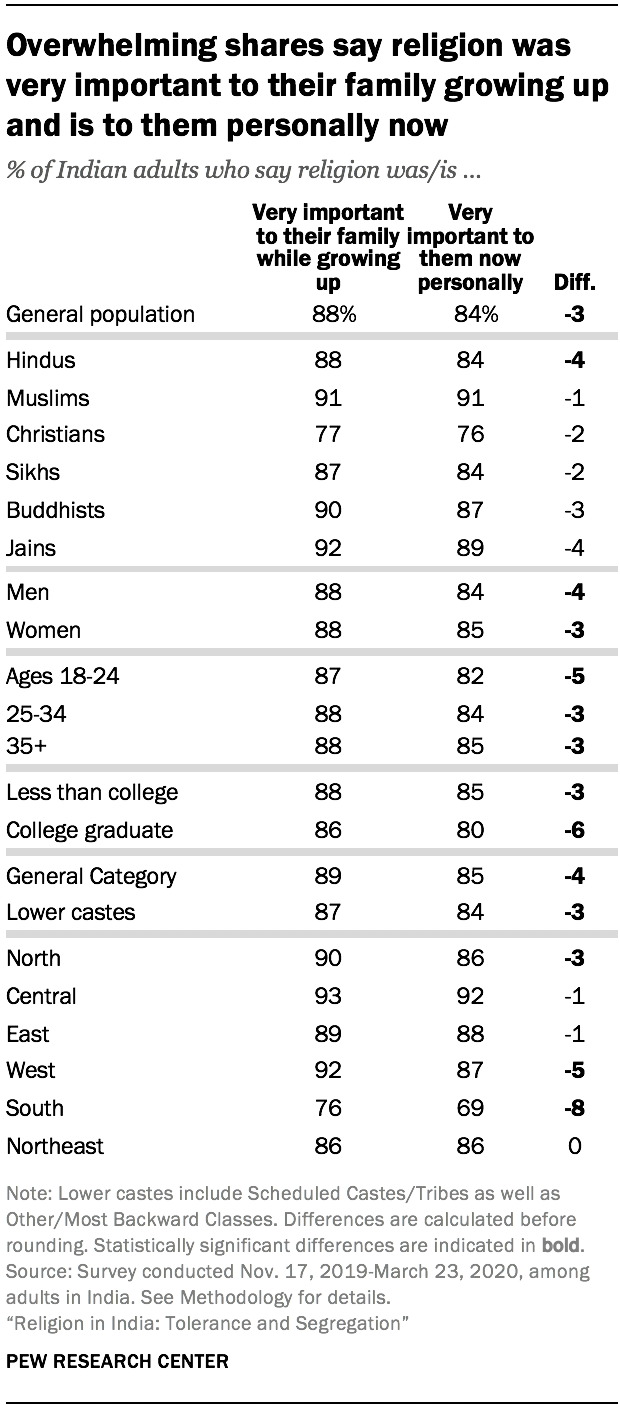
Nearly all religious groups show the aforementioned patterns. The biggest exception is Christians, amid whom those with higher teaching and those who reside in urban areas show somewhat lower levels of observance. For example, among Christians who have a higher degree, 59% say religion is very important in their life, compared with 78% amidst those who have less pedagogy.
The survey does show a slight decline in the perceived importance of religion during the lifetime of respondents, though the vast majority of Indians indicate that religion remains primal to their lives, and this is true among both younger and older adults.
About nine-in-ten Indian adults say religion was very of import to their family unit when they were growing up (88%), while a slightly lower share say religion is very of import to them now (84%). The pattern is identical when looking only at India's majority Hindu population. Among Muslims in India, the same shares say religion was very of import to their family growing up and is very important to them now (91% each).
Usa of Southern Republic of india (Andhra Pradesh, Karnataka, Kerala, Puducherry, Tamil Nadu and Telangana) show the biggest downward tendency in the perceived importance of religion over respondents' lifetimes: 76% of Indians who live in the Southward say organized religion was very of import to their family growing up, compared with 69% who say religion is personally very important to them now. Slight declines in the importance of religion, past this measure out, likewise are seen in the Western role of the land (Goa, Gujarat and Maharashtra) and in the North, although big majorities in all regions of the state say religion is very important in their lives today.
Beyond India's religious groups, widespread sharing of behavior, practices, values
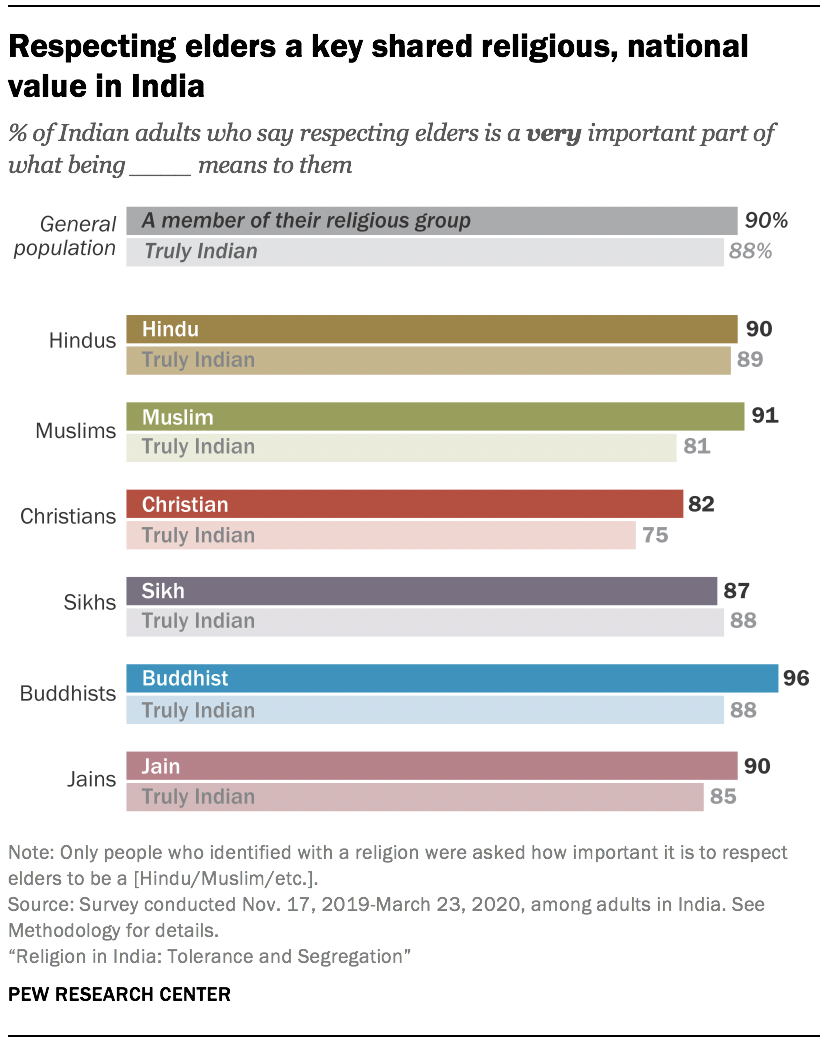
Despite a strong want for religious segregation, India's religious groups share patriotic feelings, cultural values and some religious beliefs. For instance, overwhelming shares across India's religious communities say they are very proud to be Indian, and near agree that Indian civilization is superior to others.
Similarly, Indians of different religious backgrounds agree elders in high respect. For instance, nine-in-x or more Hindus, Muslims, Buddhists and Jains say that respecting elders is very of import to what beingness a member of their religious group means to them (due east.g., for Hindus, information technology'due south a very important part of their Hindu identity). Christians and Sikhs also overwhelmingly share this sentiment. And amongst all people surveyed in all half-dozen groups, three-quarters or more say that respecting elders is very important to existence truly Indian.
Inside all six religious groups, eight-in-ten or more as well say that helping the poor and needy is a crucial part of their religious identity.
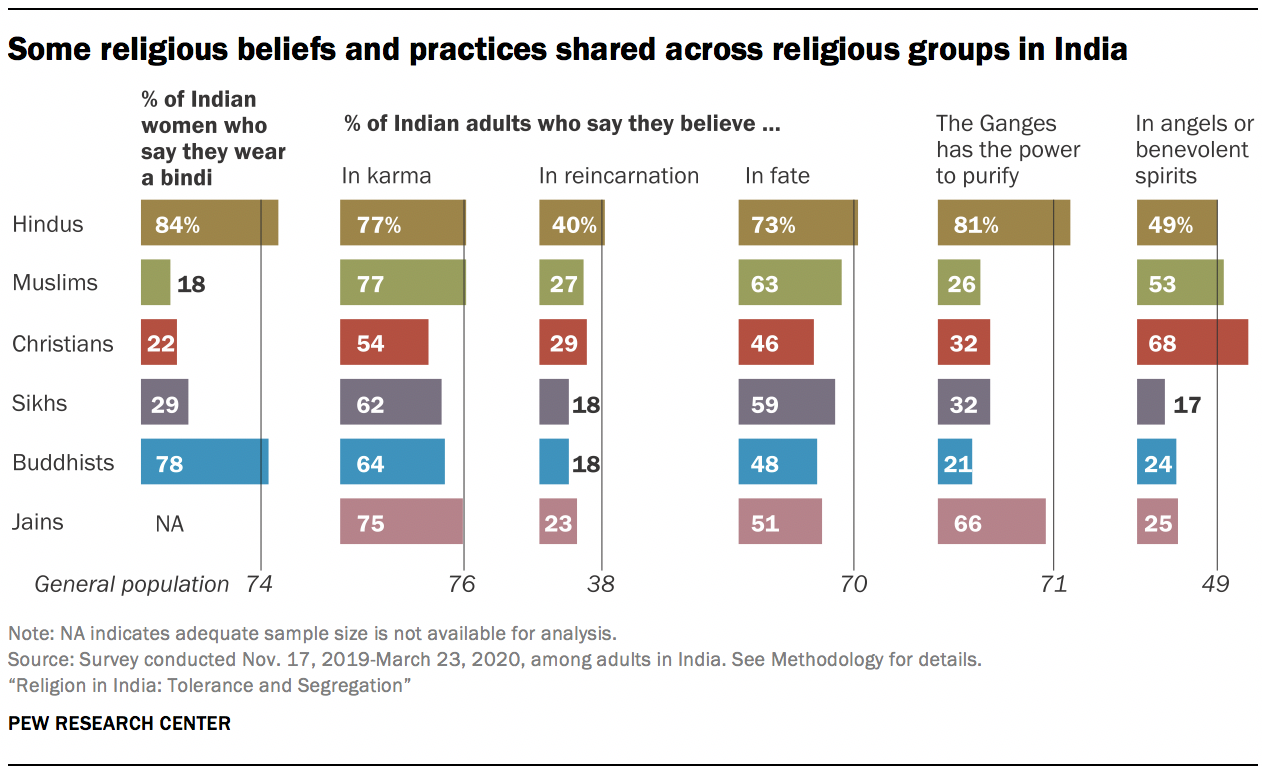
Beyond cultural parallels, many people mix traditions from multiple religions into their practices: As a result of living side past side for generations, India's minority groups often engage in practices that are more closely associated with Hindu traditions than their own. For instance, many Muslim, Sikh and Christian women in India say they wear a bindi (a brow marking, often worn past married women), even though putting on a bindi has Hindu origins.
Similarly, many people embrace beliefs non traditionally associated with their faith: Muslims in India are merely equally probable equally Hindus to say they believe in karma (77% each), and 54% of Indian Christians share this view.eight Nearly iii-in-ten Muslims and Christians say they believe in reincarnation (27% and 29%, respectively). While these may seem like theological contradictions, for many Indians, calling oneself a Muslim or a Christian does non forbid assertive in karma or reincarnation – beliefs that do not have a traditional, doctrinal footing in Islam or Christianity.
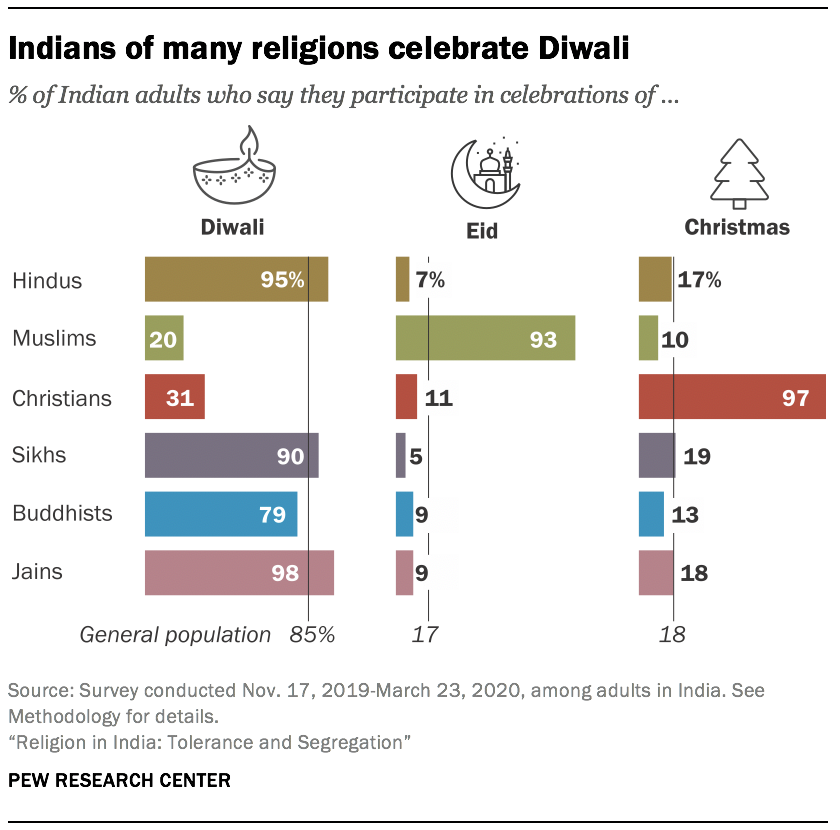
Most Muslims and Christians say they don't participate in celebrations of Diwali, the Indian festival of lights that is traditionally celebrated by Hindus, Sikhs, Jains and Buddhists. But substantial minorities of Christians (31%) and Muslims (20%) written report that they practice celebrate Diwali. Celebrating Diwali is especially mutual amongst Muslims in the W, where 39% say they participate in the festival, and in the South (33%).
Not only exercise some followers of all these religions participate in a celebration (Diwali) that consumes most of the land in one case a year, but some members of the majority Hindu community celebrate Muslim and Christian festivals, too: 7% of Indian Hindus say they celebrate the Muslim festival of Eid, and 17% celebrate Christmas.
Religious identity in India: Hindus divided on whether conventionalities in God is required to be a Hindu, but almost say eating beefiness is disqualifying
While there is some mixing of religious celebrations and traditions inside India'southward diverse population, many Hindus do not corroborate of this. In fact, while 17% of the nation'southward Hindus say they participate in Christmas celebrations, almost half of Hindus (52%) say that doing and so disqualifies a person from being Hindu (compared with 35% who say a person canexist Hindu if they gloat Christmas). An even greater share of Hindus (63%) say a person cannot be Hindu if they celebrate the Islamic festival of Eid – a view that is more widely held in Northern, Central, Eastern and Northeastern India than the Due south or West.
Hindus are divided on whether beliefs and practices such as believing in God, praying and going to the temple are necessary to be a Hindu. Merely ane behavior that a clear majority of Indian Hindus feel is incompatible with Hinduism is eating beef: 72% of Hindus in India say a person who eats beef cannot be a Hindu. That is fifty-fifty college than the percentages of Hindus who say a person cannot be Hindu if they reject belief in God (49%), never go to a temple (48%) or never perform prayers (48%).
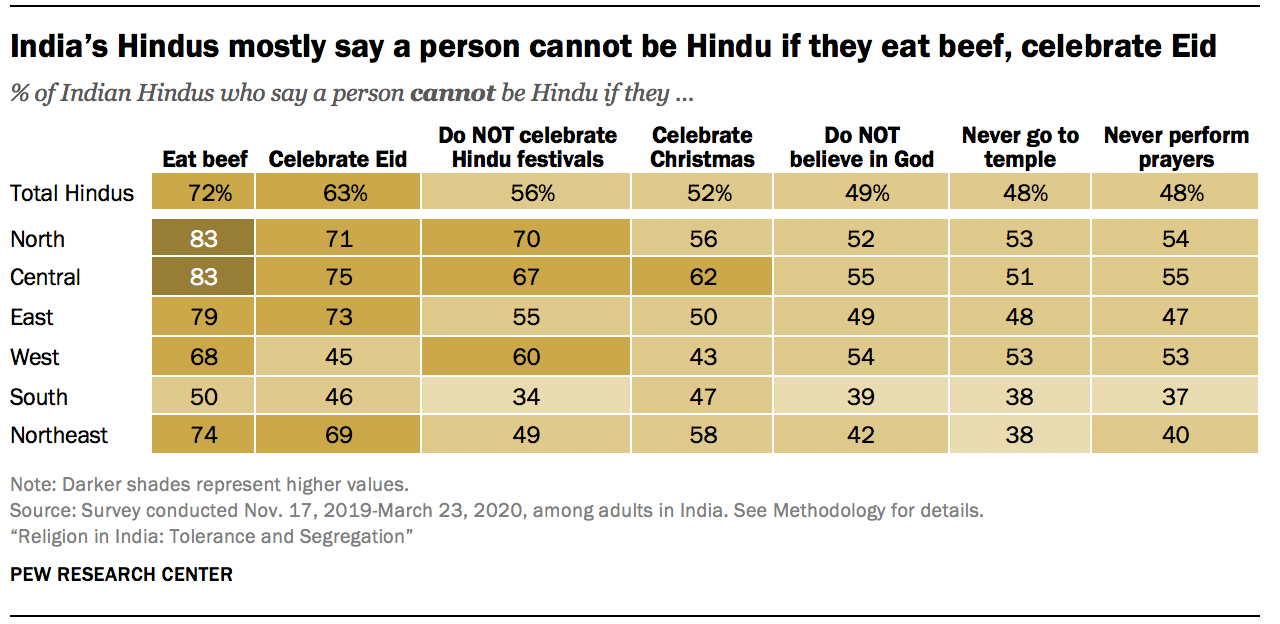
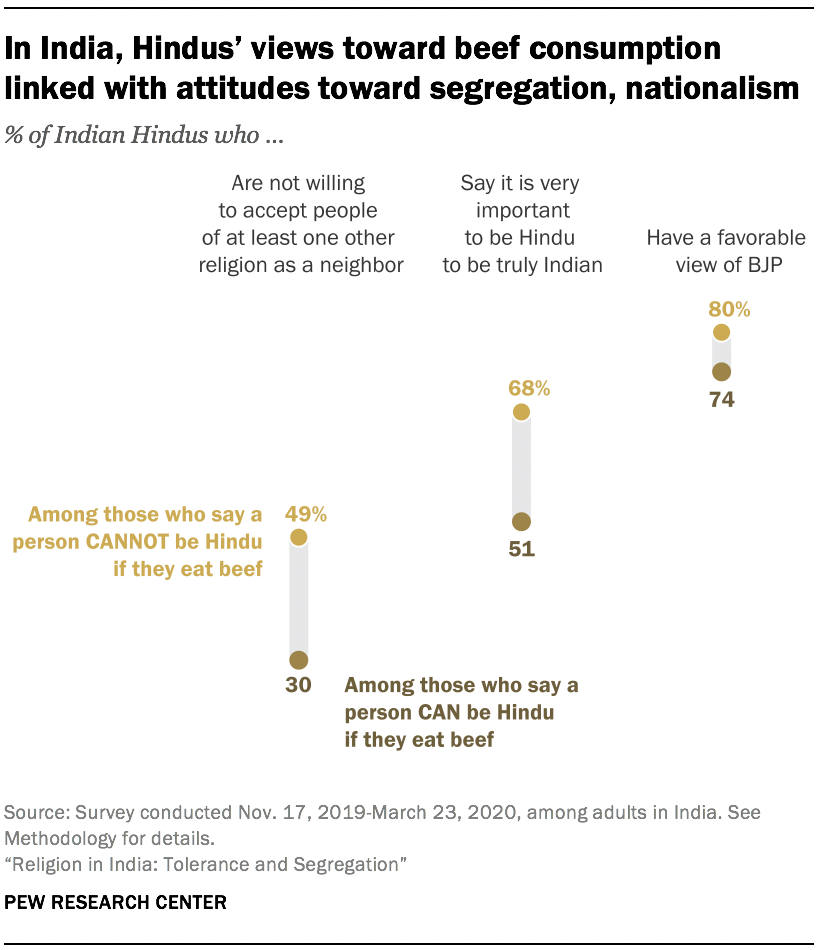
Attitudes toward beef appear to be part of a regional and cultural divide amid Hindus: Southern Indian Hindus are considerably less probable than others to disqualify beefiness eaters from being Hindu (fifty% vs. 83% in the Northern and Primal parts of the country). And, at to the lowest degree in function, Hindus' views on beef and Hindu identity are linked with a preference for religious segregation and elements of Hindu nationalism. For example, Hindus who accept a strong position against eating beef are more likely than others to say they would not accept followers of other religions as their neighbors (49% vs. xxx%) and to say it is very important to be Hindu to be truly Indian (68% vs. 51%).
Relatedly, 44% of Hindus say they are vegetarians, and an additional 33% say they abstain from eating certain meats. Hindus traditionally view cows as sacred, and laws pertaining to cow slaughter have been a recent flashpoint in Republic of india. At the same time, Hindus are not alone in linking beefiness consumption with religious identity: 82% of Sikhs and 85% of Jains surveyed say that a person who eats beef cannot be a fellow member of their religious groups, either. A majority of Sikhs (59%) and fully 92% of Jains say they are vegetarians, including 67% of Jains who exercise not eat root vegetables.9 (For more data on organized religion and dietary habits, see Chapter 10.)
The survey consistently finds that people in the Due south (the states of Andhra Pradesh, Karnataka, Kerala, Tamil Nadu and Telangana, and the matrimony territory of Puducherry) differ from Indians elsewhere in the country in their views on religion, politics and identity.
For example, by a variety of measures, people in the Due south are somewhat less religious than those in other regions – 69% say religion is very important in their lives, versus 92% in the Central office of the country. And 37% say they pray every mean solar day, compared with more than half of Indians in other regions. People in the S as well are less segregated by religion or caste – whether that involves their friendship circles, the kind of neighbors they adopt or how they feel most intermarriage. (See Chapter 3.)
Hindu nationalist sentiments also appear to have less of a foothold in the S. Amidst Hindus, those in the S (42%) are far less likely than those in Central states (83%) or the North (69%) to say existence Hindu is very important to be truly Indian. And in the 2019 parliamentary elections, the BJP'south lowest vote share came in the South. In the survey, just 19% of Hindus in the region say they voted for the BJP, compared with roughly two-thirds in the Northern (68%) and Central (65%) parts of the land who say they voted for the ruling party.
Culturally and politically, people in the South accept pushed back against the BJP's restrictions on cow slaughter and efforts to nationalize the Hindi linguistic communication. These factors may contribute to the BJP's lower popularity in the South, where more than people prefer regional parties or the Indian National Congress party.
These differences in attitudes and practices exist in a wider context of economic disparities betwixt the Southward and other regions of the country. Over time, Southern states accept seen stronger economic growth than the Northern and Key parts of the land. And women and people belonging to lower castes in the South have fared improve economically than their counterparts elsewhere in the country. Even though 3-in-ten people in the South say there is widespread caste discrimination in India, the region also has a history of anti-degree movements. Indeed, one author has attributed the economic growth of the S largely to the flattening of caste hierarchies.
Muslim identity in India
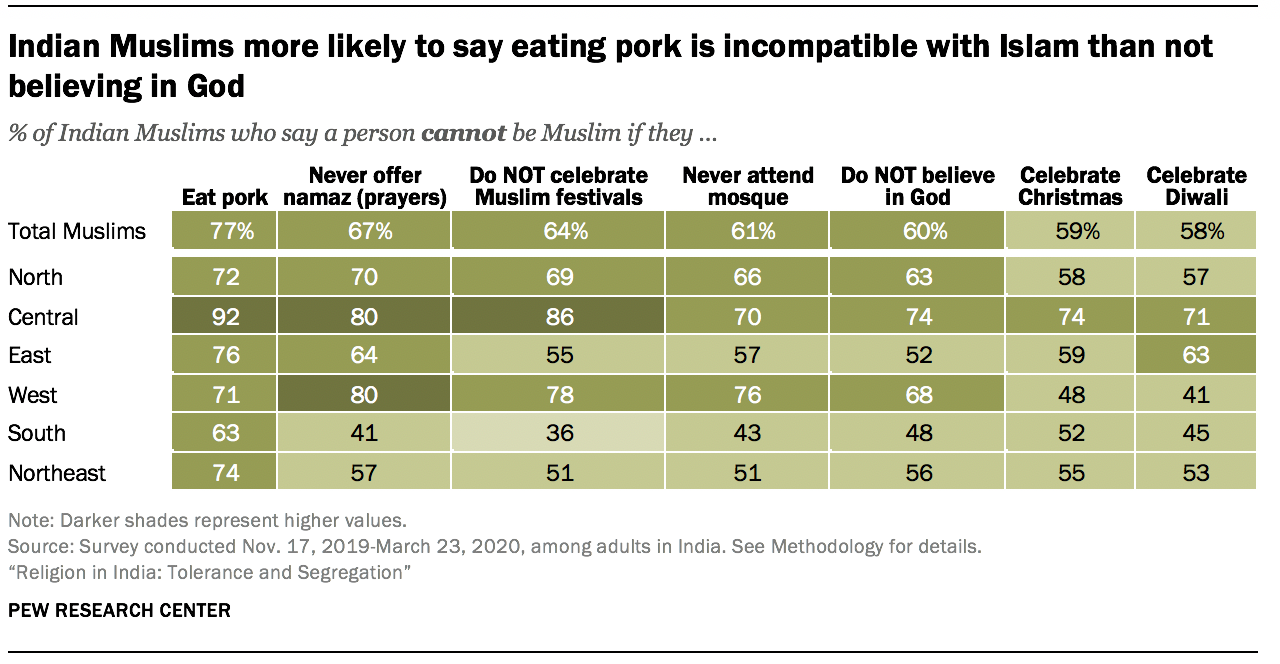
Most Muslims in India say a person cannot be Muslim if they never pray or nourish a mosque. Similarly, near six-in-ten say that celebrating Diwali or Christmas is incompatible with being a fellow member of the Muslim community. At the same time, a substantial minority express a caste of open-mindedness on who can be a Muslim, with fully ane-3rd (34%) saying a person can be Muslim even if they don't believe in God. (The survey finds that 6% of self-described Muslims in Republic of india say they do not believe in God; see "Near-universal belief in God, merely wide variation in how God is perceived" above.)
Like Hindus, Muslims have dietary restrictions that resonate as powerful markers of identity. Three-quarters of Indian Muslims (77%) say that a person cannot be Muslim if they eat pork, which is even college than the share who say a person cannot be Muslim if they do non believe in God (lx%) or never attend mosque (61%).
Indian Muslims besides report high levels of religious delivery by a host of conventional measures: 91% say religion is very of import in their lives, two-thirds (66%) say they pray at to the lowest degree once a day, and seven-in-ten say they attend mosque at least in one case a week – with even higher attendance among Muslim men (93%).
Past all these measures, Indian Muslims are broadly comparable to Muslims in the neighboring Muslim-majority countries of Pakistan and Bangladesh, co-ordinate to a Pew Research Center survey conducted in those countries in late 2011 and early 2012. In Pakistan, for example, 94% of Muslims said faith is very important in their lives, while 81% of Bangladeshi Muslims said the same. Muslims in India are somewhat more likely than those elsewhere in S Asia to say they regularly worship at a mosque (70% in India vs. 59% in Islamic republic of pakistan and 53% in People's republic of bangladesh), with the difference mainly driven by the share of women who attend.
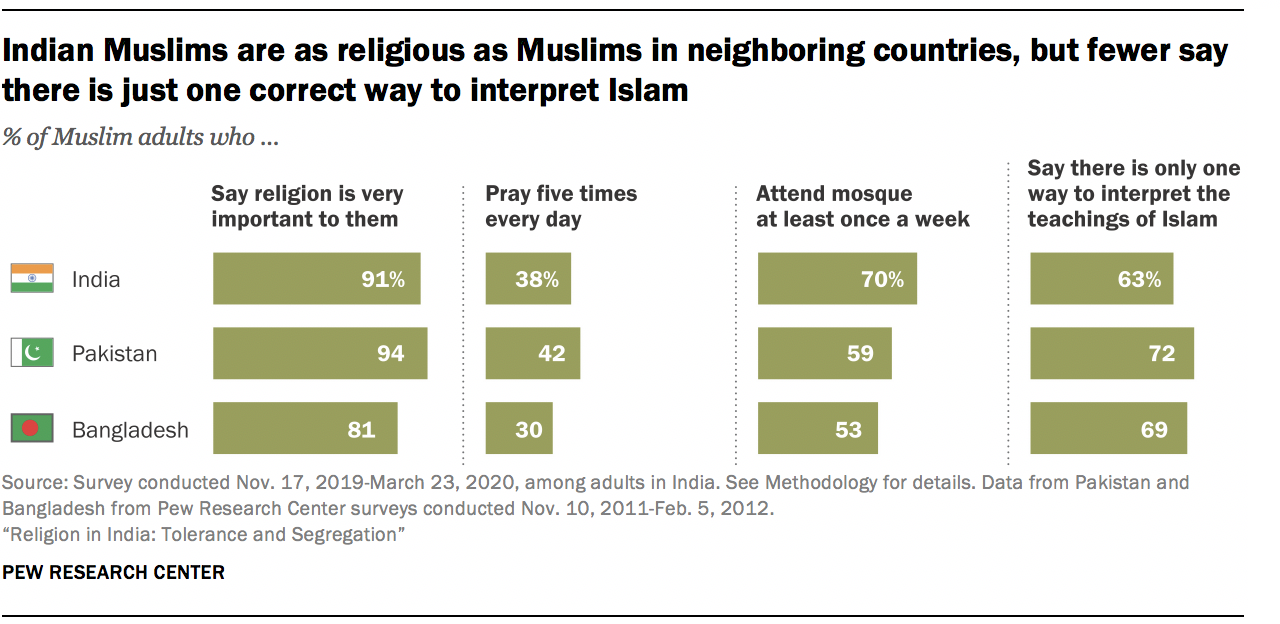
At the aforementioned fourth dimension, Muslims in India are slightly less likely to say there is "only one true" interpretation of Islam (72% in Pakistan, 69% in People's republic of bangladesh, 63% in India), as opposed to multiple interpretations.
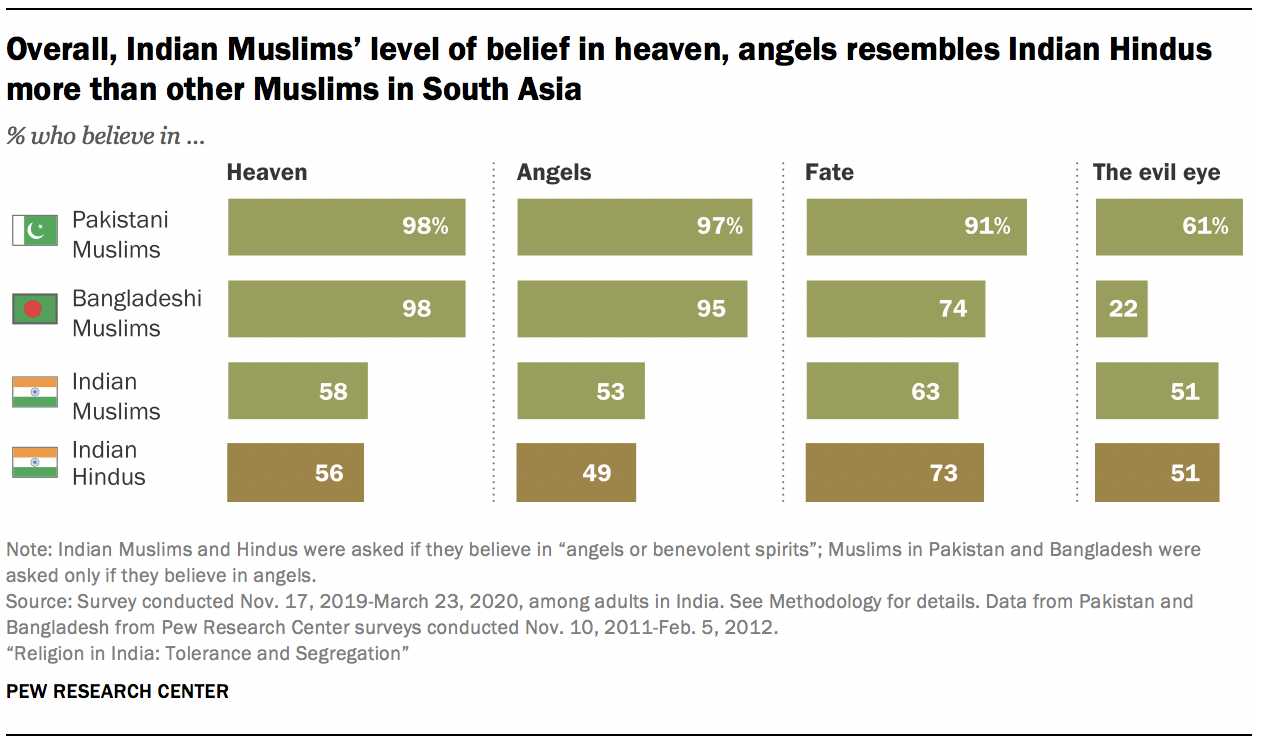
When it comes to their religious behavior, Indian Muslims in some means resemble Indian Hindus more than they resemble Muslims in neighboring countries. For example, Muslims in Islamic republic of pakistan and Bangladesh almost universally say they believe in heaven and angels, just Indian Muslims seem more than skeptical: 58% say they believe in sky and 53% express belief in angels. Amongst Indian Hindus, similarly, 56% believe in heaven and 49% believe in angels.
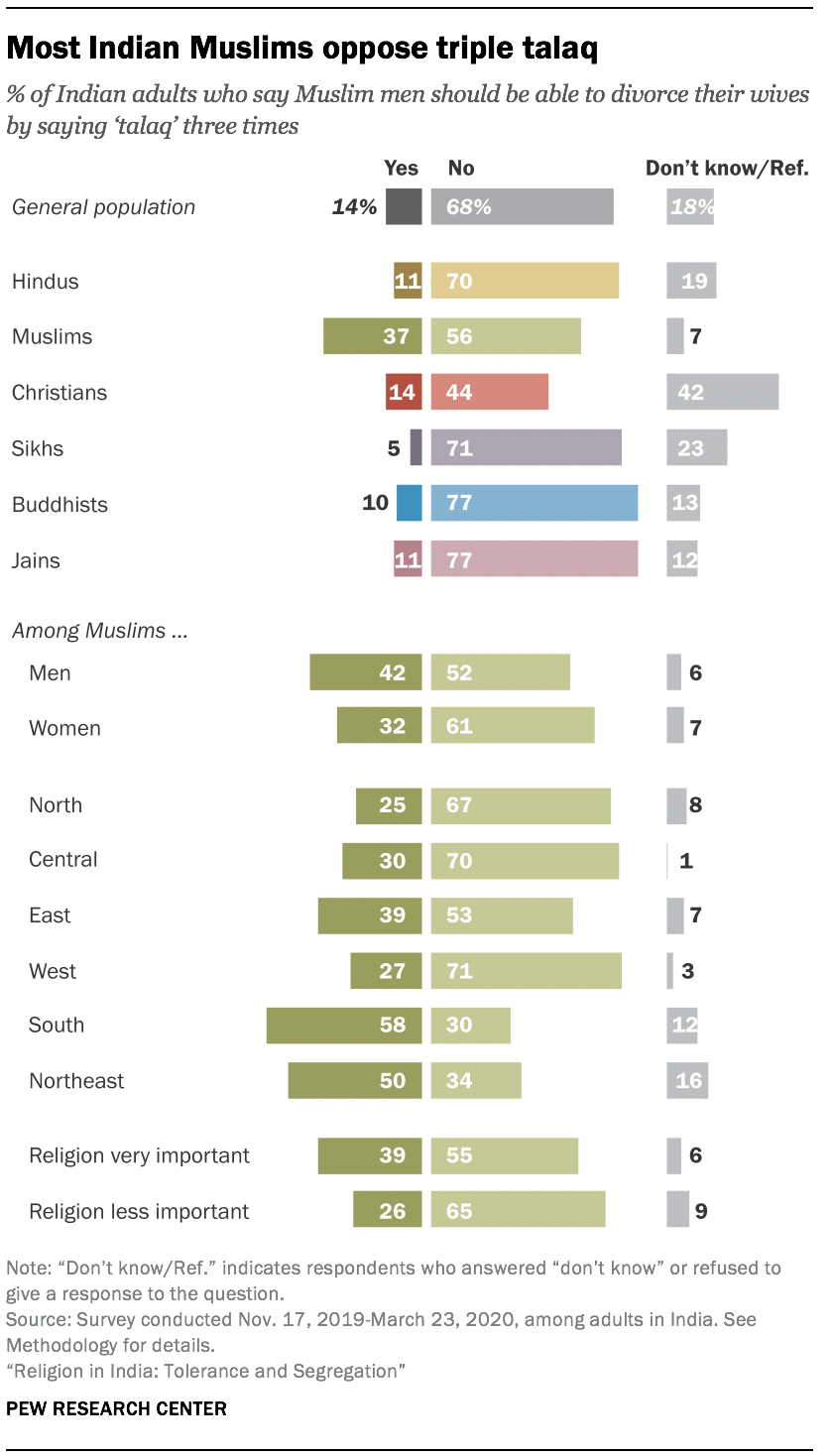
Bulk of Muslim women in Bharat oppose 'triple talaq' (Islamic divorce)
Many Indian Muslims historically have followed the Hanafi school of thought, which for centuries allowed men to divorce their wives by saying "talaq" (which translates every bit "divorce" in Arabic and Urdu) three times. Traditionally, there was supposed to exist a waiting period and attempts at reconciliation in between each utilise of the discussion, and it was securely frowned upon (though technically permissible) for a man to pronounce "talaq" three times rapidly in a row. India's Supreme Court ruled triple talaq unconstitutional in 2017, and it was banned by legislation in 2019.
Well-nigh Indian Muslims (56%) say Muslim men should not be allowed to divorce this manner. However, 37% of Indian Muslims say they support triple talaq, with Muslim men (42%) more likely than Muslim women (32%) to take this position. A majority of Muslim women (61%) oppose triple talaq.
Highly religious Muslims – i.eastward., those who say religion is very important in their lives – besides are more likely than other Muslims to say Muslim men should be able to divorce their wives simply by maxim "talaq" 3 times (39% vs. 26%).
Triple talaq seems to have the most support among Muslims in the Southern and Northeastern regions of India, where half or more than of Muslims say it should be legal (58% and 50%, respectively), although 12% of Muslims in the South and 16% in the Northeast do not accept a position on the issue either way.
Sikhs are proud to be Punjabi and Indian
Sikhism is one of four major religions – along with Hinduism, Buddhism and Jainism – that originated on the Indian subcontinent. The Sikh religion emerged in Punjab in the 15th century, when Guru Nanak, who is revered as the founder of Sikhism, became the first in a succession of 10 gurus (teachers) in the faith.
Today, Republic of india's Sikhs remain concentrated in the state of Punjab. One feature of the Sikh religion is a distinctive sense of community, besides known as "Khalsa" (which translates as "ones who are pure"). Observant Sikhs differentiate themselves from others in several ways, including keeping their hair uncut. Today, about 3-quarters of Sikh men and women in Republic of india say they keep their hair long (76%), and 2-thirds say information technology is very important to them that children in their families besides go along their hair long (67%). (For more analysis of Sikhs' views on passing religious traditions on to their children, come across Affiliate viii.)
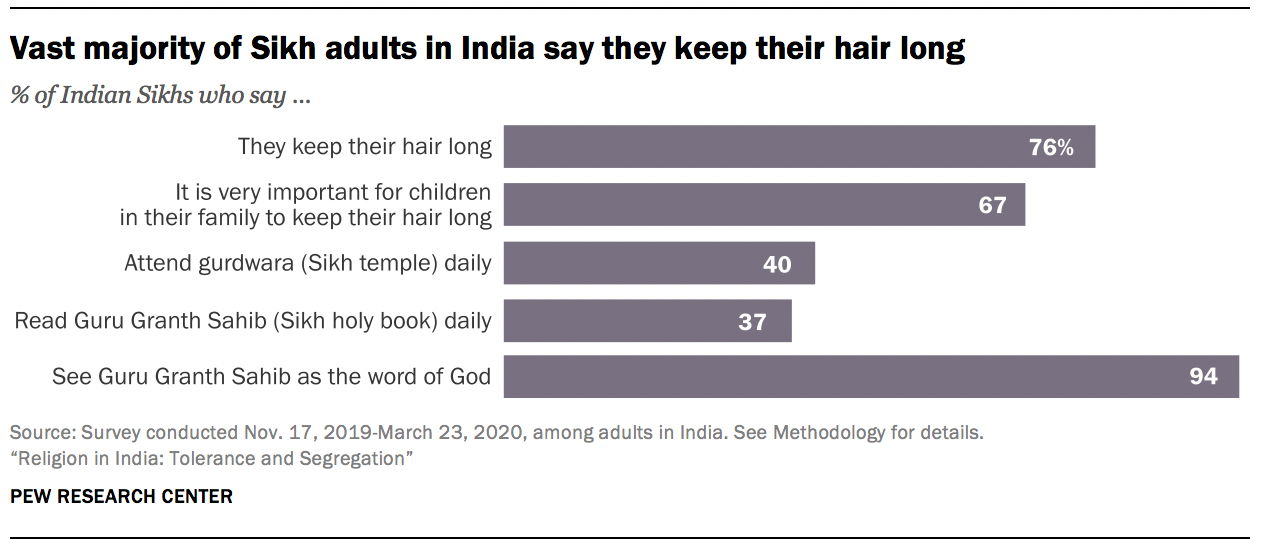
Sikhs are more than probable than Indian adults overall to say they nourish religious services every day – xl% of Sikhs say they become to the gurdwara (Sikh house of worship) daily. By comparison, fourteen% of Hindus say they become to a Hindu temple every solar day. Moreover, the vast majority of Sikhs (94%) regard their holy book, the Guru Granth Sahib, equally the word of God, and many (37%) say they read information technology, or listen to recitations of it, every mean solar day.
Sikhs in Bharat as well incorporate other religious traditions into their exercise. Some Sikhs (9%) say they follow Sufi orders, which are linked with Islam, and well-nigh half (52%) say they accept a lot in common with Hindus. Roughly one-in-v Indian Sikhs say they accept prayed, meditated or performed a ritual at a Hindu temple.
Sikh-Hindu relations were marked by violence in the 1970s and 1980s, when demands for a carve up Sikh state covering the Punjab regions in both India and Pakistan (also known equally the Khalistan movement) reached their apex. In 1984, Prime number Minister Indira Gandhi was assassinated by her Sikh bodyguards every bit revenge for Indian paramilitary forces storming the Sikh Gilded Temple in pursuit of Sikh militants. Anti-Sikh riots ensued in Northern Bharat, particularly in the state of Punjab.
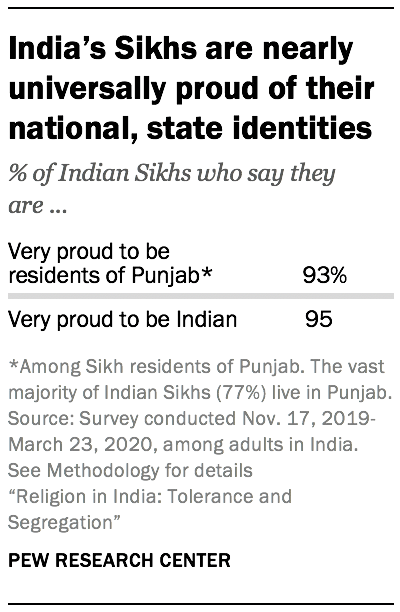
According to the Indian demography, the vast bulk of Sikhs in India (77%) nevertheless live in Punjab, where Sikhs make up 58% of the adult population. And 93% of Punjabi Sikhs say they are very proud to live in the state.
Sikhs also are overwhelmingly proud of their Indian identity. A near-universal share of Sikhs say they are very proud to be Indian (95%), and the vast majority (lxx%) say a person who disrespects Republic of india cannot be a Sikh. And like Republic of india'southward other religious groups, most Sikhs do not see evidence of widespread discrimination against their customs – just 14% say Sikhs face a lot of discrimination in India, and 18% say they personally have faced religious discrimination in the final yr.
At the same time, Sikhs are more probable than other religious communities to see communal violence as a very big problem in the country. Nearly viii-in-ten Sikhs (78%) rate communal violence equally a major issue, compared with 65% of Hindus and Muslims.
The BJP has attempted to financially compensate Sikhs for some of the violence that occurred in 1984 after Indira Gandhi's assassination, but relatively few Sikh voters (19%) report having voted for the BJP in the 2019 parliamentary elections. The survey finds that 33% of Sikhs preferred the Indian National Congress Political party – Gandhi's party.
Source: https://www.pewresearch.org/religion/2021/06/29/religion-in-india-tolerance-and-segregation/
0 Response to "Encountering the Divine Mother in Hindu and Christian Hymnsã¢ââ Religion and the Arts"
Post a Comment