How to Read Direct Currency Exchange Rates

In finance, an exchange rate is the rate at which i currency volition be exchanged for another currency. Currencies are most commonly national currencies, simply may be sub-national as in the case of Hong Kong or supra-national every bit in the instance of the euro.
The commutation rate is likewise regarded as the value of one state'south currency in relation to another currency.[i] For example, an interbank exchange rate of 114 Japanese yen to the United States dollar means that ¥114 will be exchanged for US$one or that Usa$ane will exist exchanged for ¥114. In this example it is said that the price of a dollar in relation to yen is ¥114, or equivalently that the cost of a yen in relation to dollars is $ane/114.
Each land determines the exchange rate regime that will apply to its currency. For example, a currency may be floating, pegged (fixed), or a hybrid. Governments tin impose certain limits and controls on exchange rates. Countries can likewise have a stiff or weak currency. At that place is no agreement in the economic literature on the optimal national commutation rate (unlike on the subject of merchandise where free trade is considered optimal).[2] Rather, national commutation rate regimes reflect political considerations.[2]
In floating exchange rate regimes, substitution rates are determined in the foreign exchange market place,[3] which is open to a wide range of different types of buyers and sellers, and where currency trading is continuous: 24 hours a day except weekends (i.e. trading from 20:fifteen GMT on Dominicus until 22:00 GMT Friday). The spot exchange rate is the current exchange rate, while the forward exchange rate is an exchange rate that is quoted and traded today but for commitment and payment on a specific future date.
In the retail currency exchange market, different buying and selling rates will be quoted by money dealers. Nearly trades are to or from the local currency. The ownership charge per unit is the charge per unit at which money dealers will buy foreign currency, and the selling rate is the rate at which they will sell that currency. The quoted rates will incorporate an allowance for a dealer's margin (or profit) in trading, or else the margin may exist recovered in the course of a committee or in some other way. Dissimilar rates may also exist quoted for cash, a documentary transaction or for electronic transfers. The higher rate on documentary transactions has been justified as compensating for the additional time and toll of clearing the certificate. On the other hand, cash is available for resale immediately, but incurs security, storage, and transportation costs, and the cost of tying up capital in a stock of banknotes (bills).
The retail exchange market place [edit]
![[icon]](https://upload.wikimedia.org/wikipedia/commons/thumb/1/1c/Wiki_letter_w_cropped.svg/20px-Wiki_letter_w_cropped.svg.png) | This department needs expansion. You can help by adding to it. (February 2021) |
Currency for international travel and cross-border payments is predominantly purchased from banks, foreign substitution brokerages and various forms of bureaux de modify.[ commendation needed ] These retail outlets source currency from the interbank markets, which are valued by the Banking concern for International Settlements at U.s.a.$5.three trillion per day.[4] The purchase is fabricated at the spot contract rate. Retail customers will be charged, in the form of commission or otherwise, to embrace the provider'south costs and generate a turn a profit. Ane form of charge is the utilise of an exchange rate that is less favourable than the wholesale spot rate.[5] The difference betwixt retail buying and selling prices is referred to as the bid–ask spread.
Quotations [edit]
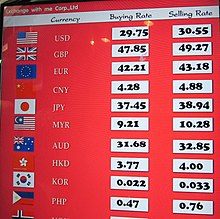
There is a market convention that rules the notation used to communicate the stock-still and variable currencies in a quotation. For instance, in a conversion from EUR to AUD, EUR is the fixed currency, AUD is the variable currency and the commutation rate indicates how many Australian dollars would be paid or received for 1 euro.
In some areas of Europe and in the retail market in the Uk, EUR and GBP are reversed so that GBP is quoted equally the fixed currency to the euro. In gild to determine which is the fixed currency when neither currency is on the to a higher place list (i.due east. both are "other"), marketplace convention is to employ the fixed currency which gives an exchange charge per unit greater than 1.000. This reduces rounding issues and the need to use excessive numbers of decimal places. There are some exceptions to this rule: for example, the Japanese ofttimes quote their currency equally the base of operations to other currencies.
Quotation using a country's domicile currency as the price currency is known as direct quotation or price quotation (from that country'due south perspective)[ clarification needed ] For example, EUR 0.8989 = USD 1.00 in the Eurozone[6] and is used in nigh countries.
Quotation using a country's home currency as the unit currency[ clarification needed ] (for instance, United states of america$i.11 = EUR i.00 in the Eurozone) is known equally indirect quotation or quantity quotation and is used in British newspapers; it is as well common in Australia, New Zealand and the Eurozone.
Using direct quotation, if the dwelling currency is strengthening (that is, appreciating, or becoming more valuable) then the exchange rate number decreases. Conversely, if the foreign currency is strengthening and the dwelling currency is depreciating, the exchange charge per unit number increases.
Marketplace convention from the early 1980s to 2006 was that most currency pairs were quoted to four decimal places for spot transactions and upward to six decimal places for forrad outrights or swaps. (The fourth decimal place is usually referred to as a "pip"). An exception to this was exchange rates with a value of less than one.000 which were usually quoted to five or six decimal places. Although there is no fixed dominion, exchange rates numerically greater than effectually 20 were usually quoted to 3 decimal places and exchange rates greater than 80 were quoted to two decimal places. Currencies over 5000 were commonly quoted with no decimal places (for example, the former Turkish Lira). e.g. (GBPOMR : 0.765432 - : 1.4436 - EURJPY : 165.29). In other words, quotes are given with five digits. Where rates are below 1, quotes frequently include 5 decimal places.[seven]
In 2005, Barclays Capital broke with convention by quoting spot commutation rates with five or half dozen decimal places on their electronic dealing platform.[8] The contraction of spreads (the difference betwixt the bid and ask rates) arguably necessitated finer pricing and gave the banks the ability to try to win transactions on multibank trading platforms where all banks may otherwise take been quoting the aforementioned cost. A number of other banks have since followed this system.[ citation needed ]
Commutation rate regime [edit]
Countries are free to cull which type of exchange rate authorities they volition apply to their currency. The main types of exchange charge per unit regimes are: gratis-floating, pegged (fixed), or a hybrid.
In complimentary-floating regimes, exchange rates are allowed to vary against each other co-ordinate to the marketplace forces of supply and demand. Exchange rates for such currencies are likely to modify almost constantly as quoted on financial markets, mainly by banks, around the world.
A movable or adjustable peg organization is a arrangement of fixed commutation rates, but with a provision for the revaluation (unremarkably devaluation) of a currency. For example, between 1994 and 2005, the Chinese yuan renminbi (RMB) was pegged to the Usa dollar at RMB 8.2768 to $1. China was not the only country to do this; from the stop of World War II until 1967, Western European countries all maintained fixed commutation rates with the Us dollar based on the Bretton Woods system.[9] But that organization had to be abased in favor of floating, market-based regimes due to market pressures and speculation, according to President Richard Thou. Nixon in a speech communication on August fifteen, 1971, in what is known as the Nixon Shock.
However, some governments strive to keep their currency within a narrow range. As a result, currencies become over-valued or under-valued, leading to excessive trade deficits or surpluses.
Exchange rate classification [edit]
- From the perspective of bank foreign exchange trading
- Buying charge per unit: Besides known every bit the purchase price, it is the price used by the strange commutation banking company to buy strange currency from the customer. In full general, the commutation rate where the foreign currency is converted to a smaller number of domestic currencies is the buying rate, which indicates how much the country'south currency is required to buy a sure amount of strange exchange.
- Selling rate: As well known equally the foreign exchange selling cost, it refers to the exchange charge per unit used past the banking concern to sell foreign substitution to customers. It indicates how much the country's currency needs to be recovered if the bank sells a certain amount of foreign exchange.
- Heart rate: The average of the bid cost and the ask cost. Commonly used in newspapers, magazines or economical assay.
- Co-ordinate to the length of delivery later foreign exchange transactions
- Spot exchange rate: Refers to the exchange rate of spot foreign exchange transactions. That is, subsequently the foreign commutation transaction is completed, the exchange charge per unit in Commitment within two working days. The commutation rate that is by and large listed on the foreign exchange marketplace is mostly referred to as the spot substitution rate unless it specifically indicates the forward exchange rate.
- Frontward exchange charge per unit: To be delivered in a certain period of time in the future, only beforehand, the buyer and the seller will enter into a contract to reach an understanding. When the delivery date is reached, both parties to the agreement will evangelize the transaction at the exchange rate and amount of the reservation. Forrad foreign exchange trading is an engagement-based transaction, which is due to the unlike time the strange exchange purchaser needs for foreign exchange funds and the introduction of foreign exchange risk. The forrad exchange rate is based on the spot commutation rate, which is represented by the "premium", "disbelieve", and "parity" of the spot commutation rate.
- Co-ordinate to the method of setting the exchange rate
- Basic charge per unit: Ordinarily choose a key convertible currency that is the most commonly used in international economical transactions and accounts for the largest proportion of foreign exchange reserves. Compare information technology with the currency of the country and set the exchange rate. This substitution rate is the basic commutation charge per unit. The key currency generally refers to a world currency, which is widely used for pricing, settlement, reserve currency, freely convertible, and internationally accepted currency.
- Cross charge per unit: Later the basic substitution rate is worked out, the substitution rate of the local currency against other strange currencies can exist calculated through the basic exchange rate. The resulting commutation rate is the cross exchange rate.
Other classifications [edit]
- Co-ordinate to the payment method in foreign commutation transactions
- Telegraphic exchange rate
- Mail transfer charge per unit
- Need typhoon rate
- According to the level of strange exchange controls
- Official rate: The official exchange rate is the rate of substitution announced by a land's strange exchange administration. Usually used by countries with strict foreign substitution controls.
- Marketplace charge per unit: The market place exchange rate refers to the real substitution rate for trading strange exchange in the gratuitous market. It fluctuates with changes in foreign commutation supply and demand weather.
- According to the international exchange rate regime
- Fixed substitution rate: It means that the exchange rate betwixt a state's currency and another state's currency is basically stock-still, and the fluctuation of commutation rate is very small.
- Floating exchange rate: It means that the monetary authorities of a country do non stipulate the official exchange rate of the country'south currency against other currencies, nor does it have any upper or lower limit of exchange rate fluctuations. The local currency is determined past the supply and demand relationship of the strange exchange market, and information technology is gratis to rise and fall.
- Whether inflation is included
- Nominal exchange rate: an commutation rate that is officially appear or marketed which does not consider aggrandizement.
- Real exchange rate: The nominal exchange rate eliminating inflation
Factors affecting the alter of commutation charge per unit [edit]
- Residue of payments: When a country has a big international remainder of payments arrears or trade deficit, information technology means that its foreign exchange earnings are less than strange exchange expenditures and its need for strange commutation exceeds its supply, then its foreign exchange rate rises, and its currency depreciates.
- Involvement rate level: Interest rates are the price and profit of borrowing upper-case letter. When a country raises its interest charge per unit or its domestic interest rate is college than the foreign interest charge per unit, information technology will cause majuscule inflow, thereby increasing the demand for domestic currency, assuasive the currency to appreciate and the foreign exchange depreciate.
- Inflation gene: The inflation rate of a country rises, the purchasing power of money declines, the newspaper currency depreciates internally, and then the foreign currency appreciates. If both countries have inflation, the currencies of countries with high inflation will depreciate against those with depression inflation. The latter is a relative revaluation of the former.
- Fiscal and budgetary policy: Although the influence of budgetary policy on the commutation rate changes of a land's government is indirect, it is as well very important. In full general, the huge fiscal revenue and expenditure arrears acquired past expansionary fiscal and monetary policies and aggrandizement volition devalue the domestic currency. The tightening fiscal and monetary policies volition reduce fiscal expenditures, stabilize the currency, and increase the value of the domestic currency.
- Venture capital: If speculators wait a certain currency to appreciate, they volition buy a large amount of that currency, which will crusade the substitution rate of that currency to rise. Conversely, if speculators expect a sure currency to depreciate, they will sell off a big amount of the currency, resulting in speculation. The currency exchange charge per unit immediately fall. Speculation is an important factor in the curt-term fluctuations in the substitution rate of the foreign exchange market.
- Government market place intervention: When exchange rate fluctuations in the strange substitution market adversely affect a country'due south economy, trade, or the government needs to achieve certain policy goals through exchange rate adjustments, monetary government can participate in currency trading, ownership or selling local or foreign currencies in big quantities in the marketplace. The strange exchange supply and demand has acquired the commutation charge per unit to change.
- Economic strength of a country: In general, high economical growth rates are non conducive to the local currency's performance in the foreign substitution market in the short term, but in the long run, they strongly support the stiff momentum of the local currency.
Emerging markets [edit]
Inquiry on target zones has mainly concentrated on the benefit of stability of commutation rates for industrial countries, but some studies accept argued that volatile bilateral substitution rates between industrial countries are in part responsible for fiscal crunch in emerging markets. According to this view the power of emerging market economies to compete is weakened because many of the currencies are tied to the United states of america dollar in various fashions either implicitly or explicitly, and then fluctuations such as the appreciation of the Usa dollar to the yen or deutsche Mark have contributed to destabilizing shocks. Almost of these countries are internet debtors whose debt is denominated in one of the G3 currencies.[x]
In September 2019 Argentina restricted the ability to purchase Usa dollars. Mauricio Macri in 2015 campaigned on a promise to lift restrictions put in place by the left-wing government including the majuscule controls which take been used in Argentina to manage economic instability. When aggrandizement rose above 20 percent transactions denominated in dollars became commonplace equally Argentinians moved away from using the peso. In 2011 the government of Cristina Fernández de Kirchner restricted the purchase of dollars leading to a rise in blackness market dollar purchases. The controls were rolled back later Macri took part and Argentine republic issued dollar denominated bonds, merely when various factors led to a loss in the value of the peso relative to the dollar leading to the restoration of upper-case letter controls to prevent additional depreciation amongst peso selloffs.[11]
Fluctuations in commutation rates [edit]
A market place-based exchange rate will change whenever the values of either of the 2 component currencies change. A currency becomes more valuable whenever need for information technology is greater than the available supply. It will become less valuable whenever demand is less than available supply (this does not mean people no longer want money, information technology just ways they adopt holding their wealth in some other grade, possibly another currency).
Increased demand for a currency can be due to either an increased transaction demand for money or an increased speculative demand for money. The transaction need is highly correlated to a country's level of business action, gross domestic production (Gross domestic product), and employment levels. The more than people that are unemployed, the less the public as a whole will spend on goods and services. Key banks typically have footling difficulty adjusting the available money supply to accommodate changes in the demand for money due to business organization transactions.
Speculative need is much harder for central banks to accommodate, which they influence by adjusting interest rates. A speculator may buy a currency if the return (that is the involvement rate) is high enough. In general, the higher a country's interest rates, the greater will be the demand for that currency. It has been argued[ by whom? ] that such speculation tin can undermine real economic growth, in particular since large currency speculators may deliberately create downward pressure on a currency by shorting in order to strength that central bank to buy their own currency to keep it stable. (When that happens, the speculator tin can buy the currency back after information technology depreciates, close out their position, and thereby brand a profit.)[ citation needed ]
For carrier companies shipping goods from one nation to another, exchange rates can ofttimes affect them severely. Therefore, nearly carriers have a CAF charge to business relationship for these fluctuations.[12] [13]
Purchasing ability of currency [edit]
The real commutation rate (RER) is the purchasing ability of a currency relative to another at electric current exchange rates and prices. It is the ratio of the number of units of a given land'south currency necessary to purchase a market basket of goods in the other country, after acquiring the other country'southward currency in the strange exchange market, to the number of units of the given state'due south currency that would be necessary to purchase that market basket directly in the given country. There are various ways to measure out RER.[14]
Thus the existent exchange rate is the exchange charge per unit times the relative prices of a market basket of goods in the two countries. For example, the purchasing power of the US dollar relative to that of the euro is the dollar toll of a euro (dollars per euro) times the euro price of one unit of the market place basket (euros/appurtenances unit) divided by the dollar price of the market place basket (dollars per appurtenances unit), and hence is dimensionless. This is the commutation rate (expressed as dollars per euro) times the relative price of the ii currencies in terms of their ability to purchase units of the market place basket (euros per goods unit divided by dollars per appurtenances unit). If all goods were freely tradable, and foreign and domestic residents purchased identical baskets of goods, purchasing power parity (PPP) would hold for the exchange rate and GDP deflators (cost levels) of the two countries, and the real commutation charge per unit would always equal i.
The rate of change of the existent exchange rate over time for the euro versus the dollar equals the rate of appreciation of the euro (the positive or negative percentage rate of change of the dollars-per-euro commutation rate) plus the inflation rate of the euro minus the inflation rate of the dollar.
Existent commutation charge per unit equilibrium and misalignment [edit]
The Real Exchange Charge per unit (RER) represents the nominal substitution rate adapted past the relative price of domestic and foreign goods and services, thus reflecting the competitiveness of a state with respect to the rest of the world.[fifteen] More in detail, an appreciation of the currency or a high level of domestic inflation reduces the RER, thus reducing the country's competitiveness and lowering the Current Account (CA). On the other hand, a currency depreciation generates an opposite effect, improving the country's CA.[sixteen]
There is prove that the RER generally reaches a steady level in the long-term, and that this procedure is faster in pocket-sized open economies characterized by fixed exchange rates.[16] Any substantial and persistent RER deviation from its long-run equilibrium level, the so-chosen RER misalignment, has shown to produce negative impacts on a country'southward balance of payments.[17] An overvalued RER ways that the current RER is to a higher place its equilibrium value, whereas an undervalued RER indicates the contrary.[18] Specifically, a prolonged RER overvaluation is widely considered as an early on sign of an upcoming crisis, due to the fact that the country becomes vulnerable to both speculative attacks and currency crisis, as happened in Thailand during the 1997 Asian fiscal crisis.[nineteen] On the other side, a protracted RER undervaluation usually generates pressure level on domestic prices, changing the consumers' consumption incentives and, so, misallocating resource between tradable and not-tradable sectors.[17]
Given that RER misalignment and, in item overvaluation, can undermine the state's export-oriented evolution strategy, the equilibrium RER measurement is crucial for policymakers.[15] Unfortunately, this variable cannot be observed. The most common method in social club to gauge the equilibrium RER is the universally accepted Purchasing Power Parity (PPP) theory, according to which the RER equilibrium level is assumed to remain constant over time. Even so, the equilibrium RER is not a stock-still value equally it follows the trend of cardinal economical fundamentals,[xv] such every bit different monetary and fiscal policies or asymmetrical shocks between the home land and abroad.[xvi] Consequently, the PPP doctrine has been largely debated during the years, given that it may signal a natural RER motility towards its new equilibrium as a RER misalignment.
Starting from the 1980s, in order to overcome the limitations of this approach, many researchers tried to notice some culling equilibrium RER measures.[fifteen] Two of the most popular approaches in the economic literature are the Cardinal Equilibrium Exchange Rate (FEER), developed past Williamson (1994),[20] and the Behavioural Equilibrium Exchange Rate (BEER), initially estimated by Clark and MacDonald (1998).[21] The FEER focuses on long-run determinants of the RER, rather than on short-term cyclical and speculative forces.[21] It represents a RER consistent with macroeconomic balance, characterized by the achievement of internal and external balances at the aforementioned time. Internal remainder is reached when the level of output is in line with both total employment of all available factors of production, and a low and stable charge per unit of inflation.[21] On the other hand, external rest holds when actual and future CA balances are compatible with long-term sustainable net uppercase flows.[22] Nevertheless, the FEER is viewed as a normative measure of the RER since it is based on some "platonic" economic conditions related to internal and external balances. Peculiarly, since the sustainable CA position is divers equally an exogenous value, this approach has been broadly questioned over time. Past dissimilarity, the BEER entails an econometric analysis of the RER behaviour, considering meaning RER deviations from its PPP equilibrium level equally a consequence of changes in key economic fundamentals. Co-ordinate to this method, the BEER is the RER that results when all the economical fundamentals are at their equilibrium values.[xvi] Therefore, the full RER misalignment is given by the extent to which economic fundamentals differ from their long-run sustainable levels. In brusk, the BEER is a more full general approach than the FEER, since it is not limited to the long-term perspective, beingness able to explain RER cyclical movements.[21]
Bilateral vs. constructive exchange rate [edit]

Example of GNP-weighted nominal exchange rate history of a handbasket of 6 important currencies (US Dollar, Euro, Japanese Yen, Chinese Renminbi, Swiss Franks, Pound Sterling
Bilateral exchange rate involves a currency pair, while an constructive exchange rate is a weighted average of a basket of foreign currencies, and it can be viewed every bit an overall measure of the land's external competitiveness. A nominal effective exchange charge per unit (NEER) is weighted with the inverse of the asymptotic trade weights. A real effective exchange rate (REER) adjusts NEER by appropriate foreign price level and deflates by the home country price level.[14] Compared to NEER, a Gross domestic product weighted constructive exchange rate might exist more than advisable considering the global investment miracle.
Parallel exchange rate [edit]
In many countries there is a distinction betwixt the official exchange rate for permitted transactions and a parallel exchange rate that responds to excess demand for foreign currency at the official commutation rate. The degree past which the parallel substitution rate exceeds the official exchange rate is known equally the parallel premium.[23]
Economic Models of Substitution Rates [edit]
Uncovered interest rate parity model [edit]
Uncovered interest charge per unit parity (UIRP) states that an appreciation or depreciation of one currency confronting another currency might be neutralized by a change in the involvement charge per unit differential. If Us involvement rates increase while Japanese involvement rates remain unchanged then the The states dollar should depreciate confronting the Japanese yen by an amount that prevents arbitrage (in reality the reverse, appreciation, quite frequently happens in the short-term, equally explained below). The future substitution rate is reflected into the forward commutation rate stated today. In our case, the forwards exchange rate of the dollar is said to exist at a discount because information technology buys fewer Japanese yen in the frontward rate than information technology does in the spot rate. The yen is said to be at a premium.
UIRP showed no proof of working afterward the 1990s. Contrary to the theory, currencies with high interest rates characteristically appreciated rather than depreciated on the reward of the containment of inflation and a higher-yielding currency.
Residuum of payments model [edit]
The residuum of payments model holds that foreign exchange rates are at an equilibrium level if they produce a stable Current account (balance of payments)current account balance. A nation with a trade arrears will feel a reduction in its foreign commutation reserves, which ultimately lowers (depreciates) the value of its currency. A cheaper (undervalued) currency renders the nation's goods (exports) more affordable in the global market place while making imports more expensive. After an intermediate period, imports will exist forced down and exports to rise, thus stabilizing the trade remainder and bring the currency towards equilibrium.
Like purchasing power parity, the balance of payments model focuses largely on tradeable goods and services, ignoring the increasing function of global capital flows. In other words, money is not but chasing goods and services, but to a larger extent, financial avails such equally stocks and bonds. Their flows go into the upper-case letter account item of the balance of payments, thus balancing the deficit in the electric current account. The increase in uppercase flows has given ascent to the asset market model effectively.
Asset market place model [edit]
The increasing volume of trading of financial assets (stocks and bonds) has required a rethink of its touch on exchange rates. Economic variables such as economic growth, inflation and productivity are no longer the only drivers of currency movements. The proportion of strange exchange transactions stemming from cross border-trading of financial assets has dwarfed the extent of currency transactions generated from trading in appurtenances and services.[24]
The asset market approach views currencies as nugget prices traded in an efficient fiscal marketplace. Consequently, currencies are increasingly demonstrating a stiff correlation with other markets, specially equities.
Like the stock exchange, money can be made (or lost) on trading by investors and speculators in the foreign exchange market. Currencies tin can be traded at spot and foreign commutation options markets. The spot market represents electric current exchange rates, whereas options are derivatives of substitution rates.
Manipulation of commutation rates [edit]
A country may gain an advantage in international trade if it controls the market for its currency to keep its value low, typically by the national fundamental bank engaging in open market operations in the foreign exchange market. Some claim that, in the early on twenty-offset century, the People's Republic of China had been doing this over a long menses of time.[25]
Other nations, including Iceland, Nihon, Brazil, and so on have had a policy of maintaining a low value of their currencies in the promise of reducing the cost of exports and thus bolstering their economies. A lower substitution rate lowers the price of a land's goods for consumers in other countries, merely raises the price of imported goods and services for consumers in the low value currency land.[26]
In general, exporters of appurtenances and services will prefer a lower value for their currencies, while importers will adopt a higher value.
Meet also [edit]
- Black Wed
- Agency de modify
- Current business relationship
- Currency strength
- Dynamic currency conversion
- Effective exchange rate
- Euro calculator
- Strange exchange fraud
- Foreign exchange market
- Financial centre
- Functional currency
- Tables of historical exchange rates to the USD
- Telegraphic transfer
- USD Index
References [edit]
- ^ O'Sullivan, Arthur; Steven K. Sheffrin (2003). Economics: Principles in activity. Upper Saddle River, New Jersey 07458: Prentice Hall. p. 458. ISBN0-xiii-063085-iii.
{{cite book}}: CS1 maint: location (link) - ^ a b Broz, J. Lawrence; Frieden, Jeffry A. (2001). "The Political Economy of International Monetary Relations". Annual Review of Political Science. iv (1): 317–343. doi:x.1146/annurev.polisci.4.ane.317. ISSN 1094-2939.
- ^ The Economist – Guide to the Financial Markets (pdf)
- ^ "Triennial Central Bank Survey: Foreign (other countries) commutation turnover in Apr 2013 : preliminary global results : Monetary and Economical Department" (PDF). Bis.org . Retrieved 23 December 2017.
- ^ Peters, Volition. "Observe the All-time British Pound to Euro Substitution Rate". Pound Sterling Live. Retrieved 21 March 2015.
- ^ Agreement foreign exchange: substitution rates Archived 2004-12-23 at the Wayback Machine
- ^ Abdulla, Mouhamed (March 2014). Understanding Pip Movement in FOREX Trading (PDF) (Study).
- ^ "Barclays upgrades eFX platform with new precision pricing". Finextra Research. seven Apr 2005.
- ^ McKinnon, Ronald I. (9 August 1999). "Euroland and East Asia in a Dollar-Based International Monetary Arrangement: Mundell Revisited" (PDF). Archived from the original (PDF) on 24 August 2006.
- ^ Edwards, Sebastian; Frankel, Jeffrey A. (2009-02-fifteen). Preventing Currency Crises in Emerging Markets. ISBN9780226185057 . Retrieved 7 September 2019.
- ^ "Argentine republic simply reinstated foreign currency restrictions. Here's what you need to know". The Washington Post . Retrieved eight September 2019.
- ^ "Currency Adjustment Cistron - CAF". Academic Dictionaries and Encyclopedias.
- ^ "Currency Adjustment Factor". Global Forwarding.
- ^ a b Erlat, Guzin; Arslaner, Ferhat (December 1997). "Measuring Annual Real Substitution Rate Series for Turkey". Yapi Kredi Economical Review. 2 (8): 35–61.
- ^ a b c d Dufrenot, Gilles J.; Yehoue, Etienne B. (2005). "Existent Exchange Charge per unit Misalignment: A Panel Co-Integration and Common Cistron Assay". International monetary fund Working Newspaper. 164.
- ^ a b c d Akram, Q. Farooq; Brunvatne, Kari-Mette; Lokshall, Raymond (2003). "Existent equilibrium exchange rates". Norges Bank Occasional Papers. 32.
- ^ a b Jongwanich, Juthathip (2009). "Equilibrium Real Exchange Rate, Misalignment, and Export Operation in Developing Asia". ADB Economics Working Paper. 151.
- ^ Di Bella, Gabriel; Lewis, Mark; Martin, Aurélie (2007). "Assessing Competitiveness and Real Commutation Rate Misalignment in Low-Income Countries". IMF Working Newspaper. 201.
- ^ Jongwanich, Juthathip (2008). "Real substitution rate overvaluation and currency crunch: evidence from Thailand". Applied Economic science. 40 (3): 373–382. doi:10.1080/00036840600570961. S2CID 154735648.
- ^ Williamson, John (1994). Estimating Equilibrium Exchange Rates. Peterson Institute for International Economics.
- ^ a b c d Clark, Peter B.; MacDonald, Ronald (1998). "Exchange Rates and Economical Fundamentals: A Methodological Comparison of BEERs and FEERs". International monetary fund Working Paper. 67.
- ^ Salto, Matteo; Turrini, Alessandro (2010). "Comparing alternative methodologies for existent substitution rate assessment". European Economy - Economic Papers. 427.
- ^ Zelealem Yiheyis (December 1998). "The Economic Determinants of the Parallel Currency Premium: Evidence from Select African Countries" (PDF). Journal of Economical Development. 23 (ii).
- ^ The Microstructure Approach to Exchange Rates, Richard Lyons, MIT Press (pdf chapter ane)
- ^ "China denies currency undervalued" commodity on BBC News on Sun, 14 March 2010
- ^ "More Countries Adopt China's Tactics on Currency" article past David East. Sanger and Michael Wines in The New York Times October three, 2010, accessed October 4, 2010
External links [edit]
 Media related to Exchange rate at Wikimedia Commons
How to Read Direct Currency Exchange Rates
Source: https://en.wikipedia.org/wiki/Exchange_rate
0 Response to "How to Read Direct Currency Exchange Rates"
Post a Comment